Where Romance and History Meet - www.heartsthroughhistory.com/

Pages

Showing posts with label western historical romance. Show all posts

Wednesday, September 7, 2011

Bonanza, Little Joe, and the Real Julia Bulette

Julia Bulette, a high priced courtesan known for her beauty and brains, arrived in Virginia City in 1858 and found herself the lone woman in a town filled with rough and desperate men who were mining the Comstock Lode. She set to work and besides her considerable feminine charms, she became known for her community support, her loyalty and her good business sense before her life came to a tragic end.

Julia’s story found its way onto the small screen in episode 6 of season 1 of the popular TV series, Bonanza, which took place around the environs of Virginia City at the time Julia was plying her trade.  In the fictionalized account, Little Joe gets captivated by the older Julia at her upscale saloon and Ben Cartwright, Little Joe’s father, is not pleased. But when a fever breaks out in Virginia City and Julia pitches, she earns Ben's admiration and he relents saying if she is what Joe wants, he won’t stand in the way. Of course, Little Joe remained single, much to the joy of female viewers everywhere. You can watch it in parts on You Tube. Here’s the first part 


The real Julia Bulette  proved that the woman of loose morals with a heart of gold was more than just a Hollywood caricature.

It was said Julia was from London, England, but of French ancestry, and came to Virginia City, Nevada by way of New Orleans and California.

Her house on D Street became a center of community life in those early days and a place to enjoy the finer things after working down under in the mines. A place of  light and charm versus dark and gloom. You had to behave as a gentleman, however, or you would not be welcome. And these rough, raw and tough men did just that.  She taught her patrons about elegance and grace and they admired her all the more for it.

The miners working the Comstock lode, whose pockets were overflowing with silver, paid dearly and, by all accounts, happily for Julia’s favors as she charged them up to $1000.00 a night. Needless to say in a short time she had the means to open her own house of pleasure, Julia’s Palace, which combined feminine companionship with wonderful French wine and cuisine.

Being an exceptional business woman, Julia “expanded her operations, importing only the most accomplished and refined girls from San Francisco.” (p. 81, Gentle Tamers: Women of the Old Wild West by Dee Brown)

As women of more respectable origins, such as the wives and daughters of the miners, arrived in the city, one would have thought Julia’s role would diminish and, like most sporting women, she would have kept in the background. But that was not Julia’s way.

She rode through the streets of Virginia City in her brougham with four aces emblazoned on the panel and crowned by a lion. She walked the streets going about her daily affairs wearing the latest Parisian fashions and sable muffs and scarves if the weather dictated. She felt part of the city and for a time, the city, at least the men of the city, embraced her. She could often be seen at the Opera in her own loge and always fashionably dressed.

Her proudest moments came from being made an honorary member of in the Virginia City Fire Company, Engine Company No. 1, voted in by the firemen themselves. Of course it didn’t hurt that her favorite lover, Tom Peasley, was the Fire Chief.  In the 1861 Independence Day celebration she was elected Queen of the parade and rode on the fire truck with a fireman’s hat on her head.

She was given other “honors” by the men of the area. “One of the Comstock Mines was named the ‘Julia’ in her honor and the best club car of the Virginia and Truckee Railroad bore the gold-plated name, ‘Julia Bulette.’ When the newly elected governor Nye came to Virginia City, it was Julia who entertained him and other state functionaries at dinner while the “good women” of the town gnashed their teeth behind closed curtains.” (p. 112, Lost Legends of the West by Williams and Pepper)

Julia was beloved by her patrons and she was loyal in return. Many stories circulated of her generosity to those down and out and her support of the city, including her plentiful donations to the fire company. She also would help the men put out fires by working the water pump and serving coffee to the fire fighters. ( p. 81, The Gentle Tamers)

When the Piute War of 1860 erupted Julia offered to stay and feed the defenders of Virginia City but the miners finally persuaded her to join a dozen or so other women in a shelter. When several hundred miners became sick after drinking water containing arsenic, she turned her Palace into a hospital and “went on duty as a nurse, soothing and comforting, and bring the patients to health on a diet of warm soup and rice.” (p.82, The Gentle Tamers)


By 1863, with a population of 30,000 Virginia City was the largest city west of Chicago and their red light district was considered superior to others in the West. ( p. 83, The Gentle Tamers). But with a population that large it was inevitable that “civilization was coming to Virginia City. Indeed by the next year, the Opera house hosted Adah Menken and Julia watched the performance from a “box behind half drawn curtains, exiled because the town had become too respectable for her.” (p. 83 The Gentle Tamers.)

But the end of Julia’s story came about not due to the encroachment of civilization but to the greediness of one of her “uncivilized” admirers who murdered her in the middle of the night in order to steal her considerable jewelry. She was found partially naked, bound, and dead come morning light.

According to reports, Virginia City, at least the male population of the town, went into mourning for her, closing down the mines and shops, hanging black wreaths from saloon windows and decorating fire trucks with black streamers. Thousands of men walked behind the black horse-drawn hearse to bury her in unconsecrated ground.

It took almost a year but finally her murderer, John Millain, (who figures as a jealous lover in the TV version) was caught and brought to trial. As Mark Twain noted in his book, Roughing It, no one was punished for murder in a wide open town like Virginia City.  John Millain would prove an exception so outraged was the town over Julia’s death. Mark Twain, who witnessed Millian’s hanging, gives a chilling account of it in his Letters from Virginia City.

“I saw it all. I took exact note of every detail, even to Melanie’s (sic) considerately helping to fix the leather strap that bound his legs together and the quiet removal of his slippers—and I never wish to see it again. I can see that stiff, straight corpse hanging there yet with its black pillowed-cased head turned rigidly to one side, and the purple streaks creeping through the hands and driving the fleshy hue of life before them. Ugh!”( State Library and Archives: A Division of Nevada Cultural Affairs, From Mark Twain, May 2, 1968)


A sad conclusion to the story of the woman whose heart of gold could not save her from the tragic fate that befell so many in her profession.

Should Julia have won Little Joe’s heart? It would have made a much happier ending but perhaps spoiled the series for so many young woman of the time.

Anne Carrole writes about cowboys who have grit, integrity and little romance on their mind and the women who love them. You can check out her contemporary romance, Re-ride at the Rodeo, at The Wild Rose Press. She also is co-editor of the review website, www.lovewesternromances.com

Friday, April 22, 2011

Newbie to Seduced By History

Hello! Since I'm new to Seduced By History I thought I'd introduce myself. I'm Christina, one of the unpubbed writers here, and I am addicted to history. I'm also a wife, a mother of four (one YA and three teenagers), and on occasion I help hubs out at the upholstery shop where I get to fawn over all kinds of antiques. I have three furbies (one Great Dane, a Lab-Mastiff mix, and a terrier. Actually the terrier belongs to my oldest, he just never moved out when she did).

I write romance anywhere from Ancient Israel to Westerns set in Kansas. There are even a few Scottish Historicals sprinkled in the mix. Did I mention I'm addicted to historicals? With the wide spectrum of historicals I found it necessary to work at building two brands. Christina Rich and Renee Lynn Scott.

Currently I'm (Renee) working on finishing up a Western and I'm (Christina) polishing my Biblical. So I'm sure you'll find a wide variety of blogs from me. It should make for interesting reading.

Are there any particular topics you'd like to see from the Biblical, Pioneer, Western eras? I'll leave the Scottish to the experts. Come to think of it, I should leave the Westerns to the experts too. ;) 

You can find me (Christina) at http://christinarich.wordpress.com/ and Renee at http://www.reneelynnscott.com/

Happy Friday,

Christina

Sunday, October 24, 2010

Have Wagon will Travel


The "soiled doves" of the wild and wooly west needed vacations, too. In the summer when the cities were hot and the men busy tending crops and cattle, some of the brothels would load up their "girls" and head to the mountains where it was cooler and they could entice the shepherds and cowboy tending the summer herds to come visit and spend money they had no place else to spend. It also made them appear "new and fresh" when they returned to the city and their usual customers.

I'd run across the fact the "girls" would go on vacations in one of my research books and didn't think much of it until my husband and I were driving around in the Steens Mountains and there was a meadow with a sign- Merry Meadow. We began asking around it was the meadow where the "girls" would vacation in the summer. There were Basque shepherds in the area and a stray cowboy would wander by, visit, and spread the word to the neighboring ranches.

Then we were watching the John Wayne movie The Cowboys and there's a scene where the cow"boys" come upon a wagon of scantily clad women. My husband laughs every time he watches that scene with the reactions of one of the boys.

Having three coincidences like that in a row, I knew a project had to include vacationing soiled doves. I'm working up that project right now.

Have you had that kind of a coincidence when things kept repeating themselves and you knew it had to be put in a book or story?

Blurb and Excerpt for Doctor in Petticoats
After a life-altering accident and a failed relationship, Dr. Rachel Tarkiel gave up on love and settled for a life healing others as the physician at a School for the Blind. She's happy in her vocation--until handsome Clay Halsey shows up and inspires her to want more.

Blinded by a person he considered a friend, Clay curses his circumstances and his limitations. Intriguing Dr. Tarkiel shows him no pity, though. To her, he's as much a man as he ever was.

Can these two wounded souls conquer outside obstacles, as well as their own internal fears, and find love?

Excerpt
“I’m going to look in your other eye now.” She, again, placed a hand on his face and opened the eyelids, stilling her fluttering heart as she pressed close. His clean-shaven face had a couple small nicks on the edges of his angular cheeks. The spice of his shave soap lingered on his skin.

She resisted the urge to run her cheek against his. The heat of his face under her palm and his breath moving wisps of wayward hair caused her to close her eyes and pretend for a few seconds he could be her husband. A man who loved her and wouldn’t be threatened by her occupation or sickened by her hideous scar.

His breathing quickened. A hand settled on her waist, slid around to her back, and drew her forward. Her hand, holding the lens, dropped to his shoulder, and she opened her eyes. This behavior on both their parts was unconscionable, but her constricted throat wouldn’t allow her to utter the rebuke.

Clay sensed the moment the doctor slid from professional to aroused woman. The hand on his cheek caressed rather than held, her breathing quickened, and her scent invaded his senses like a warm summer rain.

Paty Jager
www.patyjager.net
www.patyjager.blogspot.com

Saturday, July 24, 2010

Myths, Fables- all teach lessons


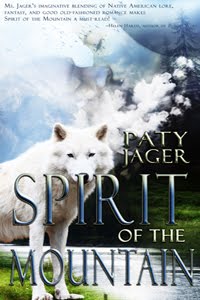
My August release, Spirit of the Mountain is available already in print format at my publisher. The Wild Rose Press. It's my first attempt at a paranormal, but to me it feels like a historical. I did major research into the Nez Perce or Nimiipuu tribe to be able to write this story about the daughter of a chief who is asked for in marriage by a warrior of the Blackfeet(Blackleg) tribe which at the time of the story were according to the words of a current Nimiipuu "considered the same as how you considered the Huns". I used this fear and hatred throughout the story when the heroine is talking and thinking about living with the Blackleg(the name the Nimiipuu called the Blackfeet).

I not only researched books on their day to day living conditions, their society, and their beliefs, I also read as much as I could in their own words. Myths and legends books and any snippet I could get that was in English but translated directly from their words. It helped me to get a feel for their speaking and cadence to their dialogue.

Here is a Nimiipuu story that I copied from the Nez Perce loop I'm on. As you can see by reading the story all of the stories handed down through the generations were like our fables. They taught a lesson.

Nez Perce boy legend

A long time ago there lived in our Blue Mountains a boy who was an only child. His parents had pampered and spoiled him until he was quite selfish and disagreeable.

His parents died and he was obliged to live with the rest of the tribe as an orphan. Because of his selfishness he was not well liked and the other children did not like to play with him. Some of the children learned that the camp was to be moved and made plans to get rid of the spoiled boy.

No one told him that they were moving and that morning they took him out to the high cattails to play hide-and-seek. They would hide and then call, "Who! Who!" Part of the time the boy was following his own echo. The children slipped away and hurried back to the camp in time to go.

The boy wandered about listening to his own echo for some time before he decided that the others had left. When he found his way back to camp it was deserted.

He was hungry and by rummaging about he found some roots that had been left. Still hungry, he decided to try some fishing. With a thorn on an improvised string he made from fibers and hair left at the camp, he placed a worm on the thorn and fished. Thus he secured fish.

Not wishing to eat it raw, his mind turned to fire, and investigation proved that someone had banked a bed of coals and he soon had a camp fire going.

Night was approaching. Where would he sleep? At last he remembered the little stone and mud igloo down by the stream where the people had taken their sweat baths. He crawled into the igloo and slept quite comfortably.

In the morning, he decided to try fishing, but this time a strange thing happened. When he felt something on his line he pulled steady and hard. Slowly it came, but it was not a fish. It was a boat loaded with many provisions and an extremely homely old lady. The old lady spoke to him, "Don't be afraid little boy, I will not hurt you. I am your Grandmother Experience. I have come to help you."

Grandmother Experience lived with him, after that and helped him do many things - make bows and arrows to kill game, gather food, build shelters, and many other things.

Time went on and the boy lived with the grandmother and grew up big and strong, but wondered where his people were. He commenced traveling about in hopes of finding them. One day he did find them and they marveled at the change he had undergone. He was no longer a spoiled selfish boy. Grandmother Experience had made a self-reliant, pleasant young man of him.

If you'd like to read an excerpt of my book Spirit of the Mountain you can visit my website: www.patyjager.net and click on paranormal. While you're there enter my website contest.
I'll be blogging for six days straight at Seriously Reviewed starting tomorrow, Sunday July 25th. Come on by and read about my hero and heroines from my last two releases. The last day I’m giving away a pdf of Doctor in Petticoats my historical western that released in June. And starting on Sunday August 8th I'm doing a six day blog tour with a contest. Check out my blog to learn more.

Monday, July 12, 2010

And the Title Is...(drumroll...)

I’m putting the finishing touches on my WIP (work-in-progress). Can’t wait to get it turned in to my editor to see how she likes it. Jenny has amazing insight in to what makes a good story and she is gentle yet truthful with her suggestions on my manuscripts. I always know she will take my story and make it better.

But the next step she’ll want to know is if I have any title suggestions. And with that my brain screeches to an undignified halt and gets mired in mud. (Some call it “creative constipation” but I’d rather not go there.) But oh, the agony and the ecstasy of it—wonderful to finish a manuscript and send it off, and … well, you know the ugly truth now. (I know—just had to throw those titles in )

The story takes place in the 1880s in San Diego, California. It involves a dispute over prime grazing land, a treasure, a woman on a mission and a man trying to keep her from getting killed in the process. Not enough info? Well, then I’ll add that along the trail, they fall in love. (This is a romance, after all )

If you need a little more inspiration, these are two pictures that remind me of my hero and heroine--Kate Hudson and Brendan Frazier.

So, the proposal is this…(I know, I know. I’ll stop now.)

Leave your title suggestion(s) here in lieu of a comment. I’ll pick the top two and those “winners” will get an autographed copy of my most recent book, Texas Wedding for their Baby’s Sake. This in no way promises use of the title upon publication (alas, authors have only minimal input on such things), but it should be fun, seeing what suggestions come up.

Saturday, June 12, 2010

Old Town ~ Where San Diego really began!


The book I'm currently working on takes place in 1888. Although much of it takes place in New San Diego, there are still parts that take place in Old Town.

Here, the San Diego River coursed by on its way to empty into the harbor where tall sails from sailing ships pierced the sky. Here, one main plaza and street bisected the small town of low red-tiled roofs and adobe buildings. A few stunted trees fought to survive in the dusty yards. A newspaper office, cantina, school house, Wells Fargo & Company, a Catholic church—built with wood transported down from the mountains or brought by boat from northern California.


It always helps me to visit the place that I'm writing about--catching the scent of the ocean breeze and the sagebrush, the warmth of the February sun against the cool shade, and the cry of the gulls--helps to infuse my writing with authenticity.


Old Town is one of my favorite places to go in San Diego. The scent of spicy Mexican food hovers in the air at meal-times which makes it nearly impossible not to purchase a churro or burritos. I can just hear the stomp of a bored burro as it waits for its owner tied outside the Colorado House, or hear a busy mother taking a moment to yell down the street after her children "Cuidado!" (Be Careful!)

It's difficult to imagine such an inauspicious beginning to a city that now sparkles like a jewel with its skyscrapers, pristine beaches, and miles of highway.

Do you live near a historic district? One that sparks your imagination of what it must have been like hundreds of years ago? If you could, would you want to time travel back to that time?


Friday, June 4, 2010

Moonlight Desperado Setting Near Castroville, Texas, and the Medina River


I thought you'd like to see some photos of the area of Texas where my novella, Moonlight Desperado, takes place.

One of the homes of my Texas ancestors became the inspiration for the house where my story unfolds. Built in Castroville, Texas in 1867, the Gerhart Ihnken home is shown below. The house faces west. The backyard is part of several acres of pastureland which slope down to the Medina River. This house reflects the architectural style of many of the Alsatian homes constructed in Castroville.

The builders of these homes were the families who came from Alsace Lorraine and settled Castroville in 1844. They traveled from France by ship. My family came in the L'Ebro. Most of the original settlers came from towns in Alsace Lorraine. Many of their homes show the same architecture and are recorded on the Historic Heritage list for Texas.


Some of the homes still have the giant old pecan trees growing in the yard.


Southwest of the Gerhart Ihnken home, the Medina River bends west before flowing south again. The photo below shows the trees growing in the Medina River along the bend. I couldn't resist describing the river and those moss covered trees, after I saw them late one day on a trip to Castroville for research about my family. Shadows beneath the trees and moss created the most mysterious and foreboding feeling.
Perfect for the beginning of Moonlight Desperado.

Scenes like the one with the trees in the Medina River are fantastic inspiration and give flight to a writer's imagination. And my werewolf writer's muse was no exception.

Have you been to Castroville, Texas? I hope you've enjoyed this quick trip to the country with me. When you're in the area, be sure to take in the atmosphere and dining in the old Alsatian town just west of San Antonio. Many thanks to the web site of Castroville for the photos. http://www.castroville.com/
Jeanmarie Hamilton
www.JeanmarieHamilton.com

Saturday, October 24, 2009

Researching your characters


I prefer researching and writing about the U.S. in the 1800's. Specifically the western U.S. However, I find myself time and again having to research farther back and overseas to fully develop my characters.

A character's roots tells a lot about that character and I find that by going back on the family tree I can develop my characters and make them more real. My problem is even though I'm researching for my book set in the west in the 1800's I have to delve into 1700's Europe sometimes.

I remember my Social Studies classes and learning all about the "boiling pot" that makes up America. I know the only true American is the Native America who has been on this continent the longest though I've also read they came from another continent as well, long, long ago. My heritage is a "Heinz 57". My mother's side being predominately German and my Dad's side Dutch, Irish, English. So even to find my ancestral background I have to travel abroad.

Which brings me to- I have a book case full of western reference books and few on European history and find myself either going online or traipsing to the library to find the research materials need when I work to "discover" family history on a character. Anyone wanting to comment and leave me some good reference books I'd appreciate it.

For my latest release, Miner in Petticoats, the heroine took some research. I wanted her Scots, but while researching for her background I found that many of the Scots at the time she would have been a girl were exiled to Ireland due to clan wars. So I put her in Ireland and she married an Irish man who was killed during the uprisings between the Irish and the English.

While none of the story takes place in Ireland, I still had to research the living conditions and the upheaval going on there to be able to give my character back story that made her who she is in this book.


Blurb:
Shouldering the burdens of his family and the mining community, Ethan Halsey devotes himself to providing for his brothers’ growing families.

However, Aileen Miller, a widow, also looking out for her family’s interests, refuses to part with the land he needs. As they battle- one to push his dream to reality and the other to prove no man will hurt her again- their lives become enmeshed and their hearts collide.

How far have you gone to build your character in your mind as well as your reader's?

www.patyjager.com

Saturday, September 12, 2009

Keeping Pace with Colloquialisms

A song states “The times they are a changin’” and that is definitely true in all things, but I want to focus on the craft of writing today and colloquialisms. They can make or break your story’s setting, not to mention the pace of the story. With competition today from TV, video games, and sports, writers have a challenge to produce the best stories possible to keep the attention of their readers. This can cover a wide continuum from slower-paced character studies to fast-paced action, but always there should be a thread pulling the reader through the storyline.


The challenge with colloquialisms is to use just enough to set the stage or the character, but not so much that it is difficult to understand and slows the pace as the reader tries to sort it out. Take Mark Twain’s Tom Sawyer as an example. Probably many of you read this book in school at one time or another. It is full of colloquialisms that give flavor to the Hannibal Missouri setting and the 1800s, but unless you’re able to immerse yourself in all that, it can be a tough read for today’s youth due to the liberally scattered expressions. Here an example: “Can’t Mars, Tom. Ole Missus, she tole me I got to go an git dis water and not stop foolin’ roun’ wid anybody.”

Other areas this crops up is in Scottish set historicals with all their dinna and verra and “Do ye no?” Oh--I do love those rolled rrrrrr's!

A writer’s job is to figure out just how many colloquialisms to use to capture the flavor of the characters and setting without distracting from the story or slowing the pacing. Considerations include whether it is a central character or a "walk-on" or "extra."

Since I write western romances, I use colloquialisms such as "waken snakes" which means to start an argument or fight. Then there is “pulled foot” which means to leave in a hurry. One of my favorite expressions is “feelin’ finer than frog hair.

Can you think of any favorite expressions that are used in your locale or ones’ you’ve read in a book? I’d love to hear some new ones…

For one lucky commenter, I’ll be giving away an autographed copy of my new release ~ Texas Wedding for their Baby’s Sake from Harlequin Historicals.

Thursday, August 13, 2009

WOMEN WHO WORK

When I first started reading romance – OK I’m one who didn’t grow up reading romance, but historical novels – I often encountered something that became one of my least favorite themes. A historical heroine with no domestic skills. I’m was always asking myself, why would the hero want a woman who couldn’t help him in anyway, can’t do anything except provide sex?

Would you believe a contemporary hero who wanted to marry a woman who not only couldn’t get a job, but couldn’t drive a car, use the phone or computer, couldn’t vacuum, cook, look after the kids, couldn’t do anything but be a bed partner. The contemporary hero, if he had enough money, could hire everything else done. But not so the historical hero. He needs a partner, a helpmate -- a wife. Even the contemporary heroine doesn’t need a man. She can hire someone to mow the lawn, fix the garbage disposal, install a new water heater.

In a historical novel one of the sub-themes is that it takes a man and a woman working together to make a go of it. A true partnership. Which, of course, is the foundation of romance.

I like historical novels where the woman is shown pulling her own weight. Where her husband-to-be/husband recognizes that he’s got a prize beyond rubies.* I like historical novels showing how women worked and the contribution they made to make the home and society function.

Of course, this does not mean that I want paragraph after paragraph as we follow the heroine through the day. But I want to see her work, her skills, the qualities the hero admires in the background as the story progresses. Everyone of us reading this knows what it’s like to work, we all do it all the time, and part of reading historical is to see ourselves reflected in the past, the past reflected in us.

In Johanna Lindsey’s Medieval novel DEFY NOT THE HEART, the knight hero, resisting marrying the lady tells his friend ‘any lusty village wench will do’. And his friend points out to him all the work involved with keeping a castle by saying ‘can you hand a villein a sword and call him a knight? It takes years of training to be knight, years of training to be a lady.’

The Medieval Lady is a woman with responsibility. She’s the one who sees that the meals are on time and of good quality, that the household is feed and clothed, the castle clean (there’s a task!!), food is stored for the winter, wool and flax are spun, woven, cut and stitched. The lady oversees the laundry, kitchen, wine cellar, buttery, linen closet, gardens, etc. She’s the CEO of the castle and the manor people.**


The Medieval lady is the ‘super mom’ of the Middle Ages. And we like the hero who recognizes his lady’s contribution. I think this is one of the reasons we love the Medieval lady of the castle, we can see ourselves in her.

If your writing about a Regency lord, what will he want in a wife? Can she handle his household, will she behave so as not to disgrace his name and family. Show her capable of making a gracious home, organizing a charity, raising his heir – whatever he considers important.

When creating a character you have to ask yourself what qualities would a hero and heroine look for in a lifetime companion (and remember, for most historical period, it was ‘lifetime’, as divorce wasn’t an option). Pretty and handsome are good, but will it bring home the bacon?

I think this sub-theme shows up best in Americana historical, which are usually set on the ‘frontier’ of the time. If you lived in next door to Daniel Boone, would you want your daughter to marry a handsome man, or one who knew how to hunt and farm so she and her children wouldn’t go hungry? Because this idea of ‘partnership’ is so appealing to me, this is why the frontier is my favorite time frame. The frontier man knows full well he needs a wife to help tame the wilderness. A man alone in the wilderness just becomes part of the wilderness.

For example, think about the movie LAST OF THE MOHICANS, do you think Nathaniel (Daniel Day Lewis) and Cora (Madeleine Stowe) are going to live exactly the same life style that Nathaniel lived before? While I loved this movie, I sometime wonder about the HEA. Do you think Daniel will go back to Europe with Cora? Probably not. So it’s a good thing that we know Cora is strong, as she’ll have to ‘hack it (a life) out of the wilderness, without so much as a by your leave’. Does she possess the domestic skills she’ll need to live in a log cabin? Probably not, but after what they’ve been through, I’m sure she can learn.

When I wrote KENTUCKY GREEN, I made sure that the background to all the scenes showed how the heroine worked. In conversation with a secondary character to give exposition, the two women are mending. In a pivotal scene where the hero acknowledges to himself he loves her, they talk while she churns butter. In COLORADO SILVER, COLORADO GOLD, the heroine is helping her uncle with some bookkeeping. Later in the day she fixed a sandwich for the hero, and I have him think how she’d been ‘at work’ at the office, and now is still working at the house.

It’s the history teacher in me that makes me want a historical novel to subtly teach something to the reader. And working women is a great sub-theme. We contemporary women can identify with the woman of the past who are always busy. And the little details of the work you put in your story add the dept that makes it realistic. And since in historicals, the HEA is, per force, marriage, I want to see a partnership that as a reader I’ll believe lasts beyond the last page of the book.

What else makes a book a keeper, than to believe in the characters and story so that they live in the readers mind after they close the book? I guess what I want is to see that the hero values the heroine beyond her pretty face and young, sexy body. Probably because I’m old enough to know that the pretty face and young, sexy body won’t last forever.

Terry Irene Blain
who after 40 years of marriage and two sons, can no longer fit into her wedding dress

*Bible (King James version) Proverbs 31:10-31, in the original language, an acrostic of the ideal wife.


**Trivia note: since the lady walked around with the keys to these various area at her waist, the key became the symbol of power, and the clinking keys eventually became a charm bracelet

Wednesday, August 12, 2009

New Release! But what's with that title?

This is a shoutout to let everyone know about my new release, Texas Wedding for their Baby’s Sake, which is officially coming out September 1st (but is available at eHarlequin now.) This sequel to The Rebel and the Lady tells the story of the younger brother, Brandon Dumont and the woman he left behind...

“Caroline Benet enjoyed one night in her fiance’s arms before he left to fight in the Texas territory. The day news reaches her of the Alamo slaughter is the day she learns she is carrying his child.


He may have survived, but Brandon can’t return to the life he once knew or the woman he once loved—not as a cripple and a man battling his own personal demons.


When Caroline shows up in Texas, Brandon is determined to send her packing. But Caroline wants more than Brandon’s name for their baby. Looks like it will take a love as big as Texas to win him back.”

Okay, okay--I've heard some remarks about the title. Yes it's long. Yes, it contains those special words that help sell a book--namely Texas, Wedding, and Baby. I've also heard that there are others out there--words that is, that help sell a book. What are your thoughts on it? Do you pick up a book based on certain words in the title? I'm curious now. And the opposite--are there any titles that make you put a book down?

No matter your take on this particular title, to celebrate its release I’m running a contest on my website this August for a free autographed copy along with a Borders Gift Card. Hope you’ll check it out! (The contest and the book!)

Wednesday, June 3, 2009

Historic Texas hotels inspire stories


The hero in my western historical romance, SEDUCTION, owns a lavish hotel with all the modern amenities available to a small town of the late 1870s in the old west. My inspiration for his hotel came from hearing family stories about various hotels, mostly in Texas where my great grandfather worked as manager in the late 1800s.

Recently I heard on the Texas news channel that the famous Tremont Hotel in Galveston is reopening after the completion of needed remodeling following last summer's destructive hurricane. The name Tremont Hotel struck a chord with me, so I checked a story about my great grandfather. Of all the hotels he managed he did not work at the Tremont, but my great great grandfather was connected to the first Tremont Hotel in Galveston. The Tremont Hotel recently remodeled is the third Tremont Hotel on Galveston according to the article I read at The Handbook of Texas Online.

My great grandfather worked at the Rice Hotel in Houston, however, and that's where he met his wife, the daughter of the grandfather connected to the Tremont Hotel and later the Rice Hotel in Houston. That in itself is enough to inspire a romance story for me, but there are more hotels my great grandfather managed that also inspire me. He managed the St. Charles Hotel in New Orleans. He managed a small hotel in Wooten Wells, Texas. There's a story.

Wooten Wells has a "build it and they will come" history. A young married couple settled there and discovered their well water turned everything either yellow or red. At first discouraged, they soon discovered the water was mineral water with wonderful curative properties. When the news got out, people flocked to Wooten Wells to bathe in the mineral water baths which the man built with the help of friends. He built houses and hotels for people to stay in, and businesses popped up as the area turned into a health resort. I won't tell you the rest of the story. You can read about it online.

My great grandfather later managed the Vogel Hotel in Dallas before taking a job with a company in El Paso. I have a copy of a menu he wrote for one day's dinner meal at a hotel named the Carson and Lewis House. I believe it was in New Orleans, and may have been associated with the St. Charles Hotel there. If anyone has any information on the Carson and Lewis House, I would love to hear it. The menu gives dinner as 12 to 2 p.m. and starts with soup, okra and tomato. Fish follows with hot salmon, roast beef, chicken with dressing, venison pie, and corn bread. Vegetables include Irish sweet potatoes, turnips, onions, rice and green peas. It lists relishes, pastry of peach cobbler and dessert with apple cake, cheese, oranges, and raisins. Beverages include coffee, iced tea, and buttermilk. The cost is seventy-five cents. This can be
helpful information for historical fiction writers of stories about the old west in the late 1800s.

Food and meals are often mentioned in romances. Meals provide an opportunity to reveal something important about the characters in the story. In all of my stories this year, including SEDUCTION, available now, and ARE YOU GOING TO THE DANCE, coming soon July 31, meals are prepared and enjoyed by the characters in various scenarios ranging from dangerous to frivolous. I hope my readers will enjoy them as much as I enjoyed writing them.

I'll be drawing someone's name from my newsletter members for a copy of one of my stories in July. So please visit my web site where you can sign up for my newsletter.

http://www.JeanmarieHamilton.com/

I'd love to read your comments or answer your questions about Historic Texas Hotels.

Tuesday, May 12, 2009

I Need A Hero!

When I start a new book, one of my favorite parts is finding a picture to use for my hero and heroine—kind of a “stand-in” model while I write. With my first book, I actually had the picture on my desk, but that drew a few subtle remarks of jealousy from my husband, so now I discreetly keep the pictures in a computer file.

You can probably identify who these actors are, but for fun I thought I’d let you guess. (Answers are at the bottom of my post)

For The Angel and the Outlaw ~ The hero is a ground-locked sea captain/suddenly father and the heroine is a feisty schoolteacher.


For The Rebel and the Lady ~
The hero is a “lone wolf” frontiersman and the heroine a Spanish landowner.


For Texas Wedding for their Baby’s Sake ~
The hero is a young physician/soldier and the heroine a southern belle.


Cover not available yet!

It will be fun to see how close the Harlequin art department comes to envisioning “my” vision of my characters.

Here are the answers ~ Mel Gibson, Kate Hudson, Kurt Russell, Catherine Zeta-Jones, Brandon Routh, and Katherine Heigl.

Now for the start of my next book... Any suggestions out there for a hero and heroine? Let me know who you would like ...
Happy Reading!
Kathryn

Friday, April 3, 2009

Western Historical, Seduction, and Inspiration from Songs ... Jeanmarie Hamilton


My book, Seduction began as an idea inspired from both a family story and Texas history. Further inspired by songs and singing, the story took shape with the heroine performing as a vocalist in a theater to support herself and build her future.

Here's the back cover summary of Seduction:

They challenged the town and each other with their forbidden affair.
Belinda Rose is two people. On stage, she's a confident vocalist who entertains her audiences. Alone, she longs for a secure home and her own opera house where she can entertain or book others to perform. She carries with her the painful memories of her past, but won't be denied her future. Can her love for a handsome businessman derail her plans? Cole MacPherson has become a wealthy entrepreneur in spite of his loveless childhood. What a shock when a beautiful singer knocks him for a loop. Could he learn to love? Does he dare?


The hero of Seduction, Cole, enjoys entertainers, including accomplished vocalists, and contracts them to perform in his theater out west in the small town of Sterling Springs.

Music has been a huge influence on my life through my mother's singing and my father's love of music. My daughter also loves music. So it was easy for me to write about a singer.

I've heard that many authors play music for inspiration and mood while writing. I'm so sensitive to music I find it very hard to think about what I want to write while music plays in the background. Even so, songs often inspire my story ideas.

The hint of a story comes to me sometimes with just one scene. It usually involves the strong feelings of only one or two characters. The emotion driving the characters in a scene often hits while I'm listening to a song.

Do you enjoy music? I like all forms of music. However, country music inspires my writing most often. Some of the slow songs by Tim McGraw have brought powerful story ideas to me. I've found inspiration for contemporary stories from Rascal Flatts' fast tempo songs. Trisha Yearwood's recordings evoke wonderful emotion for the various moods of my heroines.

A couple of my favorites other than country are Josh Groban and Bon Jovi. Some of the American Idol stars have inspired me with their powerful or sensitive renditions. For my shapeshifter historicals I find inspiration from many music sources including Robert Mirabal's dvd, Warrior Magician. The music of the movie King Arthur, with Clive Owen and Keira Knightley starring, is an amazing blend of powerful and poignant passages.

Does music help you? What music inspires you the most? I'd enjoy hearing your comments.

Jeanmarie Hamilton
http://www.JeanmarieHamilton.com
________________________________
SEDUCTION ~ out now/ Amazon.com
American Title II Contest finalist
__________________________________
ARE YOU GOING TO THE DANCE? ~ July 2009/
The Wild Rose Press
_____________________
www.titlewave.blogspot.com
www.slipintosomethingvictorian.com