Where Romance and History Meet - www.heartsthroughhistory.com/

Pages

Showing posts with label Ruth A. Casie. Show all posts

Monday, October 3, 2011

The Staff of Life in the Middle Ages

This is where it all started, the 1963 movie, Tom Jones. Albert Finney (Tom Jones) licks his chicken bones and Joyce Redman (Mrs Waters) looks like she's making love to an apple. It showed that playing with your food could be fun and anything edible will do! But what was a banquet really like?
The extravagant feasts and banquets of the Middle Ages are legendary. However, while menus for the wealthy were extensive, only small portions were taken. Hosts were expected to offer extensive choices.  With more extensive travel, a change in society emerged, possibly prompted by the Crusades, that led to a new and unprecedented interest in beautiful objects and elegant manners. This change extended to food preparation and presentation and resulted in fabulous food arrangements with exotic colors and flavorings. Banquets prepared during the Middle Ages were fit for a king.
Staffing and Presenting the Banquet
The kitchen squires where responsible for provisioning the kitchen. Assisted by the cooks, they chose, purchased, and paid for the goods.
The food was plated on the serving dishes and staged in the kitchen until it was time to bring to the tables in the Great Hall.
The Noble of the castle, and his distinguished guests, sat at a great table that was set on a raised platform, a dais, at one of the hall.
Buffets were tables with a series of wooden stepped shelves. The number of shelves indicated the host’s rank. The more shelves the higher the rank. The 'Stepped Buffets' were covered with rich drapes and used at banquets and feasts. The Nobles impressed their guests by using their finest gold or silver plates as service plates on the buffet.
The banquet feast consisted of three, four, five, and even six courses. At times the presentations of the main courses were made into a theatrical representation with colored jellies of swans or peacocks or pheasants with their feathers. Served as a specialty the beak and feet of these birds were gilt and placed in the middle of the table as a centerpiece.
French Medieval Banquets
The French cooking historian described a great feast given in 1455 by the Count of Anjou, third son of King Louis II of Sicily. This description demonstrates just how theatrical a presentation can be:
“On the table was placed a centre-piece, which represented a green lawn, surrounded with large peacocks' feathers and green branches, to which were tied violets and other sweet-smelling flowers.
In the middle of this lawn a fortress was placed, covered with silver.
The fortress was hollow, and formed a sort of cage, in which several live birds were shut up, their tufts and feet being gilt.
On its tower, which was gilt, three banners were placed.
The first course consisted of a civet of hare, a quarter of stag which had been a night in salt, a stuffed chicken, and a loin of veal.
The two last dishes were covered with a German sauce, with gilt sugar-plums, and pomegranate seeds.
At each end, outside the green lawn, was an enormous pie, surmounted with smaller pies, which formed a crown. The crust of the large pies were silvered all round and gilt at the top.
Each pie contained a whole roe-deer, a gosling, three capons, six chickens, ten pigeons, one young rabbit, and, no doubt to serve as seasoning or stuffing, a minced loin of veal, two pounds of fat, and twenty-six hard-boiled eggs, covered with saffron and flavoured with cloves.
For the three following courses, there was a roe-deer, a pig, a sturgeon cooked in parsley and vinegar, and covered with powdered ginger.
The feast continued with a kid goat, two goslings, twelve chickens, as many pigeons, six young rabbits, two herons, a leveret, a fat capon stuffed, four chickens covered with yolks of eggs and sprinkled with spice, a wild boar, some wafers and stars and a jelly, part white and part red represented the crests of the honored guests, cream covered with fennel seeds and preserved in sugar, a white cream, cheese in slices, and strawberries, and, lastly, plums stewed in rose-water
Besides these four courses, there was a fifth, entirely of wines then in vogue, and of preserves. These consisted of fruits and various sweet pastries.”
I researched medieval banquets when I wrote Knight of Runes.  Eating is fundamental and enjoyable. While Arik and Rebeka don’t get it on quite like Tom and Mrs. Waters there is definitely an air of the playfulness in the scene.  The trouble with watching that scene is I really get hungry. I’ll let you figure out for what!
Ruth A. Casie 
Pre-Sale Now Available for Knight of Runes

Saturday, September 3, 2011

The Renaissance and Women


It has long been held that the Renaissance began in Florence, Italy in the 14th century mostly because of the social and civic uniqueness of the city at that time.  The Renaissance was a cultural movement that saw the rise of literature, science, art, religion, and politics. It was an intellectual transformation that bridged the Middle Ages and Modern era.
Women in the Renaissance were primarily the domestic caretakers of the children and the household. They were subordinate inferiors of men. Only a few wealthy women escaped the tasks of making clothes from scratch, the overall maintenance of the home, and production of food. In the Middle Ages master craftsmen worked out of the family home. The women of the house not only did their womanly chores but also took on responsibilities in the family business. In the 13th century, the family business was removed from the home to larger shops in a different location.  It’s during this time period that crafts became individual male trades thus removing the women in the household from participating while she kept house. However, fathers and husbands who stood to profit from the careers of their daughters and wives were not likely to oppose their participation. However, this was not a very common situation. Historians believe women filled a greater variety of professional roles, had more responsibilities, and had more economic contribution during the Middle Ages rather than the Renaissance.  
Like the Middle Ages, women of the Renaissance were denied all political rights and considered legally subject to their husbands. A woman was controlled by her parents throughout her childhood, and then handed directly into the hands of a husband, whom she most likely had not chosen herself, and who would exercise control over her until her death or his. Unmarried women were not emancipated but lived under the subjugation of a male relative or in a convent where she could become a nun, the only profession allowed to women.
The heroine in my book, Knight or Runes, is a 21st century renowned Renaissance scholar. She is an independent take control person. She has a black belt in martial arts and is a survival and rescue expert. When she’s tossed back into 17th century England she’s challenged by the repressive attitudes about women. You’ll have to read the book (it comes out November 14) to see how she fares but how would you cope and survive? What would be your biggest challenge?  

Tuesday, July 5, 2011

Women of Revolution

Today, Americans celebrate Independence Day. It’s a time for waving flags, marching in parades, and eating grilled hot dogs and hamburgers. We speak about our Founding Fathers and the sacrifices they made. We don’t hear very much about the women.
How it started: Spurred by what the colonists considered unjustly levied taxes on imported tea, the British commanders in the colonies and the colonists came to an impasse. The colonists rebelled and dumped the tea that was waiting to be off loaded into Boston Harbor (the Boston Tea Party). The British Prime Minister, Lord North, passed a series of laws in retaliation, the Intolerable Acts, which resulted in the American Revolution.  
Loyalists and Rebels: Some people sides with the British and others with the colonists. Women of the day did not, for the most part, hold jobs but were responsible for the household. But the feelings and activities of the revolution permeated political, civil, and domestic life. Some women stayed loyal to the Crown. Other women rebelled by boycotting British goods, spying on the British, following and working with the army, and some even fighting,
Organizers: Women organized various associations to help the war effort. Esther Deberdt Reed (wife of the Pennsylvania Governor), Sarah Franklin Bache (daughter of Benjamin Franklin), in Philadelphia, collected funds which Martha Washington took to her husband, General George Washington. Women in other states followed their example and raised over $340,000 for the American war effort.
Sarah Franklin Bache
Esther Deberdt Reed
Baggage: Other women, whose men went off to war, were left the hardship of holding onto their homes and protecting their families with little help. Many of these women were easy prey for marauding soldiers. Some women refused to stay behind and followed the army. The commanding officers called these women “necessary nuisances” and “baggage.” But these women played an important role, too. They served the soldiers and officers as wash women, cooks, nurses, seamstresses, supply scavengers, sexual partners and even prostitutes.
Margaret Corbin
Fighters: There were women who did not follow the army but joined the army, some disguised as men. Some, like Anna Maria Land and Margaret Corbin, did it to be near their man and others, like Anne Bailey (under the name of Samuel Gay) and Anne Smith, joined for the enlistment bounty, money for enlisting. Several women, Deborah Samson and Hannah Snell, were able to hide their gender and were given honorable discharges from the service.
Spies: There were women who acted as couriers and rode through enemy lines carrying documents and letters under their petticoats. Deborah Champion, Sara Decker, and Harriet Prudence Patterson Hall all managed to sneak documents past the British.
Abigail Adams
Not Quite Equal: The ideals of liberty, equality, and independence the Founding Fathers professed didn’t impact women. Women continued to be associated with home and hearth and they were not welcome in politics. They confined their political views to their personal writings. Only a few, like Abigail Adams and Mercy Otis Warren became public figures. But the woman’s role held importance none the less. It was the woman’s role to pass on the ideals of independence to their children so it would prosper, grow, and become part of the very fabric of the colonist’s lives.
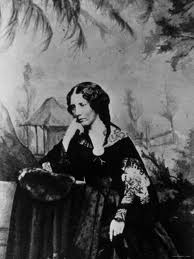
Harriet Beecher Stowe
The Power of the Female Pen: One woman would be looked upon by President Lincoln as “…the little woman who made this great war.” He was speaking of the American Civil War and Harriet Beecher Stowe. Her story, Uncle Tom’s Cabin, ignited a spark in the North while she indicted slavery in the south. Her story sold over 300,000 copies in America and Britain which may represent only 1/10 of the audience it really reached. She definitely demonstrates the power of the pen.  There is a great review by Andrew Delbanco, director of American studies at Columbia, of David S. Reynold’s newly released book, Mightier Than the Sword, in this Sunday’s New York Times Sunday Book review.  

Tomorrow, Americans celebrate Independence Day. It’s a time for waving flags, marching in parades, and eating grilled hot dogs and hamburgers. It’s also a great day to relax and read a book. Who knows, it could change the world.

Friday, June 3, 2011

The Druids

 Last month’s offering was about the ancient Avebury stones in Southern England. The stone circles and megaliths that pre-date written history leave much to the imagination. It’s no wonder they are the setting for mystical and magical stories. The Druids, a mystical order of people, have spurred legends and stories of magic, human sacrifice, and ancient rites. It seems like a match made in heaven!
The earliest references to Druids are in the writings of Julius Caesar. He cited Greek and Roman texts from 200 BCE. These now lost early writings depicted the Druids as wise Celtic elders. The responsibility of these elders was to memorize the history and knowledge of their tribe and pass the information on to the next generation to ensure the future of their society.
The Druids, with their revered knowledge, played an important role in society and were a respected warrior class. They were a single authority responsible to act as judge, a lifelong position passed down in secret, to the next generation. This elite training, held in caves and forests, along with their herbalist expertise and the later development of the Ogham alphabet, associated with the Celtic lunar tree calendar, may have led to the summation that Druids were strongly linked to nature. Their vast knowledge gave them unequaled power over their people.
They met annually at a sacred place in a region owned by the Carnute tribe in the heart of Gaul. Gaul was a large area in Western Europe that is now France, Luxembourg, Belgium, as well as parts of Switzerland, Northern Italy, the Netherlands and Germany.
Without any written history, it is difficult to know the ritual, political and clerical practices. However, if we look at documented Celtic history we could make some assumptions about the druids.
The ancient Druids were priests, teachers, physicians (herbalists), legislators, astronomers, chemists, musicians, poets, theologians, philosophers, diviner, and judges of their time. Their insight was highly respected and their religious, judicial, and scholastic authority was absolute. Viewed as the conduit between the people and the gods, they handed down their knowledge orally from generation to generation.
Druid beliefs focused on the supreme power of the universe and the belief that the soul was indestructible/ immortal and after death passed on to another. Because of the diverse geography and number of tribes and cultures that made up the Celts, there were a variety of gods. This is one of the strongest factors in supporting the theory that Druids did not teach religion but rather taught their philosophy which gave order to the many different structures, instilled morals, virtues and ethics. So strong was the teaching that aristocrats, even kings, sought out Druids to teach their children. Because druidic instructions were memorized verses, none of the verses have survived.
Claims that Druids participated in human sacrifice are uncertain. Caesar claimed they sacrificed criminals by burning them in a wicker effigy, the wicker man. But other authorities claim Caesar’s information is all propaganda to demonize the Druid and justify his move to eradicate them.
Because the common people held them in such high regard, the Romans feared them. It was this reverence that prevented the success of Caesar’s invasion of Briton in 55 BCE. As a result, Caesar ordered their extinction. While almost successful a few Druids survived by hiding or converting to Christianity.
As with any invading and winning army, the Christian church absorbed the Celtic religion. Many of the pagan gods and goddess had new life as Christian saints with many sites that held spiritual significance becoming locations of cathedrals. By the 7th century CE, Druidism was all but destroyed or had gone into hiding.
In medieval tales from Ireland, the Druids were portrayed as sorcerers with super natural powers. In the 18th and 19th centuries, fraternal groups and neo-pagan organizations revitalized the ideas held by the Druids and there was a resurgence in Druidic beliefs. Today, modern Druidism is one of the pagan religions which include Wicca, Asatru, Shamanism.

With my story, Knight of Runes, the magical element of Druids and time travel fit nicely with the stones at Avebury. 

Tuesday, May 3, 2011

A Sacred Site

I entered a contest after I wrote Knight of Runes, not with hopes of winning, which would have been awesome, but rather for feedback. More than anything, I wanted feedback.
I did very well in the contest actually. Well, according to two of the three judges anyway. The swing in the third set of scores was, well that's a blog for another day. Suffice it to say, I placed well but didn’t win. But I did get the feedback. Awesome!
My story is a time travel. Our heroine says the right words, carries the correct talisman, and is standing in the right spot. The constellation of events transports her back in time 400 years. I set the magic place at Stonehenge.  I know I took some ‘poetic’ license. The great stones now stand protected behind a fence. No longer can visitors walk around them.  
One judge noted that she lived near some great stones that were about as old as Stonehenge and had no barriers. The stones stand proudly amidst the village of Avebury, Wiltshire County in southern England.
Avebury is impressive. The henge is made up of sets of standing stones in set patterns surrounded by a ditch and bank. While erosion and vandalism, to say nothing of religious persecution (even for a stone), has reduced the henge, it remains breathtaking. Construction at Avebury started about 3000 B.C., when the central part of the henge, the Cove, was built. Archeologists estimate this to be about the same time that the first stones at Stonehenge were set in place. Construction of the Avebury henge moved outward and lasted for several centuries finishing with the a great circles that define its border. Within the larger circle, sitting side by side are two smaller circles. The outermost circle covers almost 29 acres with a circumference of almost 1 mile. It is the largest stone circle in Europe and the best known prehistoric site in Britain. 
These circles are much larger than the more famous Stonehenge. As a matter of fact, Stonehenge would fit into the outer stone circle at Avebury around 130 times.

 In the early Saxon period, about 600 A.D., a small settlement was built that was went inside and outside the henge. It is surmised that the settlers thought it a semi-fortified area. A Benedictine church and priory were built in 1114 A.D. Later in the 12th century, the church suppressed pagan rituals. The more prominent stones were given names associated with the devil. Many of the stones were toppled and buried. Today, a large portion of village still resides inside the Avebury circle. 
The Cove is the area of the henge where Rebeka, my heroine, is drawn into the time portal.  Like the rest of the henge, it’s been a long held belief that the stones represent male and female characteristics. A male scientist must have done this designation as male stones are long and thin while the female is short and square. The two surviving primary stones at the Cove are perfect examples.  I thought the Cove the perfect place for Rebeka’s adventure to begin. 
Where does your favorite adventure begin?