Where Romance and History Meet - www.heartsthroughhistory.com/

Pages

Showing posts with label Caroline Clemmons. Show all posts

Thursday, October 6, 2011

INDULGING OUR FANTASIES

19th Century cabin
One of the greatest things about writing is that authors are able to indulge their own fantasies. One of mine is that I would have loved living in the West during the last part of the 1800’s. Maybe! At least until the weather was severe and I had no central heat/air, no clean bathroom with running water, no antibiotics, and on and on. It’s a romantic time to consider, which is why I love writing romances set in the American West (probably much more than I would like returning to that time).

Maureen O'Hara
Another of my fantasies is that I wanted to look like the young Maureen O’Hara. More’s the pity, for I look nothing like her. But we’re talking about fantasies, right? This is why Cenora Rose O’Neill, the heroine of my 2010 western romance, THE TEXAN’S IRISH BRIDE, strongly resembles Miss O’Hara in appearance. What authors can’t accomplish ourselves, we accomplish through our characters.


When the infamous 1845 Irish potato famine struck and millions in Ireland literally starved to death, there was a mass immigration of Irish into the United States. But the O’Neill family didn’t lose their land in the famine. They were turned off many years later by a spiteful landlord. Due to her lack of schooling, Cenora cannot read cursive and reads only a few words in print. Her father, Sean O’Neill, can read a newspaper (slowly), and has done all the reading for his family and their traveling companions. On the other hand, the McClintocks value education, and Dallas McClintock reads most evenings. This difference causes only one of the many conflicts that arise in the book.


Irish cottage
When forced off their plot of Irish land with only what they could carry, Cenora and her family fell in with a group of Irish Travelers. The Travelers, or tinkers, are not gypsies but are descended from medieval minstrels and poets who traveled Ireland telling myths and stories. In medieval times, the minstrels and poets were respected and learned. Many Irish families turned out of their homes drifted in with the traveling minstrels, eventually becoming the Irish Travelers--not so respected or learned. Travelers have their own language (cant), Sheldroo, which--amazingly enough--is linked by scholars to medieval language. They camped in fields at first. Later they acquired tents, then the colorful wagons that resemble gypsy wagons, such as the ones used in my novel. Like people everywhere, some Irish Travelers are good, some are bad. The same is true for those portrayed in THE TEXAN’S IRISH BRIDE.


Irish fields
The 19th and early 20th century Traveler wagons are unbelievably compact, and are brightly painted inside and out in red, blue and green with yellow pinstripes. Seeing them in several museums brought home the skill and functionality of these wagons. That describes the two wagons acquired by the O’Neills through their ability to play instruments while Cenora sings for crowds when they pass through towns. Unfortunately, Sean O’Neill’s only abilities are playing music and the gift of gab--not much to supply a family’s needs. His sons Finn and Mac trade ponies for a bit of extra coin and the family barely gets by. On the other hand, rancher Dallas McClintock has a strong work ethic and sense of honor. You can see more trouble looming, can’t you?
 In THE TEXAN’S IRISH BRIDE, Cenora Rose O’Neill knows her father somehow arranged the trap for Dallas McClintock, but she agrees to wed the handsome stranger. She’d do anything to protect her family, and she wants to save herself from the bully Tom Williams. She believes a fine settled man like Dallas will rid himself of her soon enough, but at least she and her family will be safely away from Williams.


Texas rancher Dallas McClintock has no plans to wed for several years. Right now, he’s trying to establish himself as a successful horse breeder. Severely wounded rescuing Cenora from kidnappers, Dallas is taken to her family’s wagon to be tended. He is trapped into marrying Cenora, but he is not a man who ever goes back on his word. His wife has a silly superstition for everything, but passion-filled nights with her make up for everything—even when her wild, eccentric family nearly drives him crazy.


I hope you’ll read and enjoy THE TEXAN’S IRISH BRIDE. The gorgeous cover is one of my favorites. The buy link for THE TEXAN’S IRISH BRIDE is www.thewildrosepress.com/caroline-clemmons-m-638.html in print and e-download, and it’s also available at Amazon and other online stores. My website is http://www.carolineclemmons.com/. Other books at The Wild Rose Press are the contemporary romance HOME, SWEET TEXAS HOME, historical SAVE YOUR HEART FOR ME, and paranormal time travel OUT OF THE BLUE. My backlist is now available on Smashwords and Amazon Kindle for 99 cents each, and so is my new mystery, ALMOST HOME.

Monday, September 5, 2011

BAD HAND - COL. RANALD MACKENZIE

Mackenzie Park in Lubbock, Texas
A part of Yellow House Canyon

Growing up in Lubbock, Texas we attended what seemed to me a dozen reunions at Mackenzie Park each summer. I knew the park and one of our junior high schools were named for a military man, but nothing else about him, especially not that he went insane. I must have missed the day that was covered in Texas History class. Allegedly, Mackenzie had contracted syphillis, a destroyer of the brain if left untreated. His nickname of Bad Hand came from his losing part of his hand in a battle. His exploits were legendary, and it's said he was fearless and seemed indestructable. Although I find it hard, especially as one whose great grandmother was Native American, I try to see him as he would have been regarded in his time. Whether you view him as a hero or a villain, here's his story.

Ranald Mackenzie
Ranald Slidell (Bad Hand) Mackenzie, army officer, was born on July 27, 1840, in New York City, the son of Alexander Slidell Mackenzie, a popular author and naval officer who had taken his mother's family name of Mackenzie, and Catherine (Robinson) Mackenzie. (I suspect there’s an interesting story there!) Alexander Mackenzie was a Captain in the Navy, but he made a bad career move when he hung the son of the Secretary of War for mutiny.

Ranald received his education at Williams College and at the United States Military Academy, where he graduated on June 17, 1862, at the head of his class. He was commissioned a second lieutenant and assigned to the Army of the Potomac. Within two years he had fought in eight major battles and been promoted to the rank of colonel. Later, in the Shenandoah Valley, he commanded troops in five battles, and in the final campaign against Robert E. Lee he was a brevet major general. At Appomattox he took custody of surrendered Confederate property and afterward commanded the cavalry in the Department of Virginia. In three years he had received seven brevets and six wounds.

Buffalo Soldiers
In 1867 Mackenzie accepted an appointment as colonel of the Forty-first Infantry, a newly formed black regiment reorganized two years later as part of the Twenty-fourth United States Infantry. The unit had its headquarters at Fort Brown, Fort Clark, and later at Fort McKavett. On February 25, 1871, he assumed command of the famed Black Buffalo Soldiers, the Fourth United States Cavalry at Fort Concho (San Angelo, TX) and a month later moved its headquarters to Fort Richardson (Jacksboro TX).


Mackenzie awarding medals
That summer he began a series of expeditions into the uncharted Panhandle and Llano Estacado (the staked plain) in an effort to drive renegade Indians back onto their reservations. In October his troops skirmished with a band of Comanches in Blanco Canyon, where he was wounded, and on September 29, 1872, they defeated another near the site of the present town of Lefors. In 1873 Mackenzie was assigned to Fort Clark to put an end to the plunder of Texas livestock by Indian raiders from Mexico. On May 18, in an extralegal raid, he burned a Kickapoo village near Remolino, Coahuila , and returned with forty captives. That and effective border patrols stopped the raiding.


In July 1874 Lt. Gen. Philip H. Sheridan ordered five commands to converge on the Indian hideouts along the eastern edge of the Llano Estacado. Mackenzie, in the most daring and decisive battle of the campaign, destroyed five Indian villages on September 28 in Palo Duro Canyon (near Amarillo, TX) and on November 5 near Tahoka Lake (Tahoka, TX) won a minor engagement, his last, with the Comanches. His destruction of the Indians' horses after the battle of Palo Duro Canyon, even more than the battle itself, destroyed the Indians' resistance.


Comanche Chief Quanah Parker
In March 1875 Mackenzie assumed command at Fort Sill and control over the Comanche-Kiowa and Cheyenne-Arapaho reservations. On June 2 Quanah Parker arrived at Fort Sill with 407 followers and 1,500 horses. The Red River War was over.


After Lt. Col. George A. Custer's troops had been annihilated on the Little Bighorn River in 1876, Mackenzie was placed in command of the District of the Black Hills and of Camp Robinson, Nebraska. In October he forced Sioux Chief Red Cloud, who had won a campaign in 1868 against the United States, to return his band to the reservation.


On November 25 Mackenzie decisively defeated the Northern Cheyennes. After a short tour of duty in Washington, during which he commanded troops mustered to keep the peace in the event of disturbances following the presidential election of 1876, Mackenzie returned to the Black Hills, then to Fort Sill Oklahoma. In late 1877 Indians from Mexico were again raiding in South Texas, and by March 1878 Mackenzie was again at Fort Clark. He began patrols and in June led an expedition into Mexico. His incursion prompted the Mexican government to act, and by October the raiding had ceased.


Mackenzie
In October 1879 Mackenzie was sent to Colorado with six companies of cavalry to prevent an uprising of the Utes at the Los Pinos agency. The Indian Bureau eventually negotiated a removal treaty, but the chiefs refused to leave until Mackenzie informed them that the only alternative was war. Two days later, the Utes started for Utah. On September 2, 1881, Mackenzie received orders to move his cavalry to Arizona, take field command of all troops there, and subdue the Apaches. After a short and brilliant campaign, despite the opposition of the department and division commanders, Mackenzie was assigned on October 30 to command the District of New Mexico, where the Apaches ignored departmental and international lines and the Navajos were restless. Within a year the army was in control.


Mackenzie was promoted to the rank of brigadier general, but was seriously ill. He had taken several medical leaves during the last few years. On October 27, 1883, he was reassigned to command the Department of Texas. He planned to marry and retire soon on land that he had bought near Boerne, TX. The day before his marriage he went into a store, broke a chair, and threatened the store owner with the chair leg. He was restrained, babbling and incoherent. (A narrow escape for his bride-to-be!) By December 18 he was declared suffering "paralysis of the insane." A few days later he was escorted to New York City and placed in the Bloomingdale Asylum. Reportedly, he did not speak or respond. On March 24, 1884, he was retired from the army. In June he went to his boyhood home in Morristown to live with a cousin. In 1886 he was moved to New Brighton, Staten Island, where he died on January 19, 1889. He was buried in the military cemetery at West Point.


According to Johnny Hughes of Lubbock, Texas: “In this part of West Texas, Colonel Ranald "Bad Hand" MacKenzie is seen as the hero of the Indian wars of the 1870s. There were so-called battles in all our area canyons: Yellow House, Blanco, Tule, White River, and the last and largest battle of the Red River Wars, in Palo Duro Canyon against Quanah Parker, and several tribes. MacKenzie had to spend more time killing people than anyone in American history. He entered the Civil War in 1862. Right after the Civil War, he began leading cavalry charges on Indian villages against dozens of tribes in several states and Mexico. This went on until 1880.


Palo Duro Canyon near Amarillo
"In several of the canyons, the bleached bones of the horses remain. In the final big ‘battle’ in 1875 in Palo Duro Canyon, MacKenzie burned all the lodges in five villages, and all the food stored for the winter. His troops captured 1400 horses. They kept 300 and shot the rest. They kept an accurate count on the horses, mules, and ammunition, but the number of Indians who died as a result of this government policy has not been written. MacKenzie led white and black soldiers, the famous buffalo soldiers.


"With winter approaching, the Indians were left without food, horses, blankets, warm clothes, or a place to hide. Most surrendered to face a long, cold, hungry walk to Oklahoma. Those that surrendered to the cavalry were in a herd on foot, and herded like cattle or horses.”

The 1958-1959 syndicated television series, "Mackenzie's Raiders," starring Richard Carlson in the title role, is loosely based on Mackenzie's time in Texas. According to Johnny Hughes, the scene in “Dances With Wolves” where Kevin Costner rides around between rebel and union lines was based on Ranald Mackenzie.


Caroline Clemmons is the author of HOME, SWEET TEXAS HOME, a contemporary sweet romance set in and near the West Texas towns of Lubbock and Tahoka, Texas. http://www.carolineclemmons.com/  her blog is at http://carolineclemmons.blogspot.com/
Buy link is www.thewildrosepress.com/caroline-clemmons-m-638.html

Saturday, August 6, 2011

NEW GRANGE, IRELAND AND OENGHUS, GOD OF LOVE


New Grange Megalithic Burial Mound in Ireland
Listed by UNESCO as a World Heritage Site, New Grange in Ireland was built around 3250 BC. That’s 500 years before the Egyptian pyramids and 1,000 years before Stonehenge. Brú na Bóinne, means mansion on the Boyne, and the passage tomb lies in the Boyne River Valley. The site receives over 200,000 visitors a year. New Grange access is by guided tour from the Brú na Bóinne Visitor Centre located close to the village of Donore, County Meath.


Entrance stone
The kidney shaped mound covers an area of over one acre and is surrounded by 97 kerbstones, some of which are richly decorated with megalithic art. The 62-foot long inner passage leads to a cruciform chamber with a corbelled roof. It is estimated that the construction of the Passage Tomb at New Grange would have taken a work force of 300 at least 20 years. At winter solstice, rays of the morning sun fall through a small opening in the mound’s roof box to illuminate the burial chamber for 17 minutes. Can you imagine waiting a year for 17 minutes of light? Can you imagine the precision required to accomplish that feat?


Pre-Celtic Design
The 12-inch diameter tri-spiral design from inside the chamber is probably the most famous Irish Megalithic symbol, and is one third the size of the same design on the entrance stone. It is often referred to as a Celtic design, but it was carved at least 2500 years before the Celts reached Ireland. At 12 inches in diameter the tri-spiral design is quite small in size, less than one-third the size of the tri-spiral design on the entrance stone.


Megalithic mounds such as Newgrange entered Irish mythology as sídhe or fairy mounds. New Grange was said to be the home of Oenghus, the god of love. Oenghus mac ind Og ("He Alone Who is Powerful") was the God of love and youth, patron god of children. The alternate spelling is Angus.

Oenghus is the son of the Dagda, ruler of an other-dimensional realm of beings known as the Tuatha de Danaan, a race of beings who were worshipped as gods by the Ancient Celts and Gaels of Western Europe, and Boann, the goddess of the Boyne River of County Meath in Eire (modern Ireland). Boann was the wife of the water-god, Nechtan, who settled Brú na Bóinne after the defeat of the Fomore, the eternal enemies of the Danaans. As Chieftain of the Tuatha de Danaan, the Dagda sent Nechtan on a day long errand, and in his absence, seduced Boann. Using his mystical powers, the Dagda extended the day to last nine months so that Boann conceived and gave birth to Oenghus in a single day. Oenghus was given to his brother, Mider, to be raised to adulthood, but when Oenghus became an adult, Nechtan gave Brú na Bóinne to Oenghus, possibly seeing him as his only worthy heir.

The Tuatha de Dannan were worshipped as gods throughout Ireland, Britain and Western Europe with the Dagda as King of Eire and Oenghus taking his throne in his absence. However, when the Dagda retired from Earthly rule, he split Eire up among four counties among his sons with Oenghus acquiring Leinster, Mider receiving Connacht, Oghma receiving Ulster and his brother Bodb Derg receiving Munster. Bodb as the eldest son also acquired the title as King of Eire at Meath, kept separate from the other four counties. During the Milesian invasion, the Danaans departed Earth for the realm of Otherworld connected to the Earth's dimension by way of countless sidhs or faerie mounds throughout Eire. Oenghus's sidh was located at Brú na Bóinne.

Oenghus took Derbrenn, the daughter of King Eochaidh Airem of Eire as his wife, but he eventually fell in love with Caer, the daughter of Ethal Anubal and grand-daughter of King Ailill and Medhbha of Connacht. Caer had appeared to him in a vision, and Oenghus turned to his older brother, Bodb, in order to identify and find the mystery woman in the vision. Using his spells, Bodb finally found Caer a year after the dream alongside the bank of a lake in Connacht with her numerous sisters. Oenghus approached Ethal Anubal for the right to court Caer. He learned that Caer was actually a mortal shapeshifter with her sisters, only able to live half a year on Earth in human form and the other half of the year as a swan. The reason for this spell is unrevealed, but Oenghus learned from King Ailill that the best way to court Caer was to take her as a swan and convince her to remain human. Following his instructions, Oenghus confronted Caer on the Feast of Samhain and followed her into the sky as she turned to a swan, becoming a swan himself. Enchanting a mystical spell to her in song, he finally encouraged her to fly away with him to Brú na Bóinne to live as his wife. After he out-lived her, he took a third wife, Nuamaisi.

In the First Century BC, Oenghus was sent in his capacity as a god of love to woo the Princess Edain of Ulster on Mider's behalf. In the Third Century AD, he adopted Diarmaid ua Duibhne, the son of a fallen Celtic lord. Oenghus placed a spell around Diarmaid to encourage women to fall in love with him. While he attended the wedding of Igraine, a princess of Eire to the aged warrior, Finn mac Cumhaill, Oenghus was noticed by Igraine, who fell in love with him and drugged her husband and guests to escape with Diarmaid and a otherwise potentially unhappy future. Igraine's father, King Cormac of Eire sent the Fianna to retrieve her, but Oenghus protected and sheltered the lovers for several years. (Igraine should not be confused with Igraine, the mother of King Arthur.)

In the Fifth Century AD, Christianity was introduced to Eire and the Celtic Gods retreated from Earth for the last time for the dimension of Otherworld which included the realms of Avalon and Tir Na Bhog. Oenghus left Brú na Bóinne to his mortal descendants. His modern day activities are unrevealed.


Now back to New Grange. The Passage Tomb at New Grange was re-discovered in 1699 by the removal of material for road building. A major excavation of New Grange began in 1962; the original facade of sparkling white quartz was rebuilt using stone found at the site.
Check your bookseller for a list of the numerous books that focus on New Grange, on other megalithic monuments in Ireland, and on Irish mythology.

Aerial view
Thanks to www.Knowth.com for part of this information and photos. To celebrate the Irish part of my heritage, I’ll give away a PDF copy of either my historical, THE TEXAN’S IRISH BRIDE, or the contemporary time travel romantic suspense, OUT OF THE BLUE, to one commenter.

Thanks for stopping by.
Caroline Clemmons


Thursday, July 7, 2011

SALLY SCULL - THE LEGEND OF MUSTANG JANE

AUSTIN
Let me share the legend of a woman about whom I’ve recently learned. Sally Newman, the woman later called “Mustang Jane” by her vaqueros, was born in Illinois in 1817 to Rachel (nee Rabb) and Joseph Newman. Her parents followed her maternal grandparents through several states to eventually settle in southeastern Texas and become part of Stephen F. Austin’s “Old Three Hundred.” (Sorry if you’re not familiar with Texas history, but Stephen F. Austin’s 300 is a really big deal in Texas history.) As a pioneer wife, Mrs. Newman was no stranger to conflict. On at least two occasions, she thwarted Indian attacks on her home from Comanche or Apache with quick and decisive action while young Sally watched.

 Two years after her father's death when she was fourteen, Sally  registered the brand for the cattle she had inherited from her father. Although she registered the brand in her maiden name, she noted on the application that she was the wife of Jesse Robinson, a man eighteen years her senior. The alliance lasted for ten years before Jesse filed for divorce in 1843 because she "was a hellion to live with, a shrew of the worst sort." Angered, she also filed for divorce. Custody of their children, Nancy and Alfred, was given to Jesse. Sally kidnapped Nancy, but the court forced her to return Nancy to Jesse.


Why is it some strong women pick weak husbands? Sally’s luck with her second--George Scull; third--John Doyle; fourth--Isaiah Watkins; and fifth husband--Chris Horsdorf (so despised by those who knew him he was called "Horsetrough"), was no better. In fact, each sounded less desirable or less intelligent than the one he'd followed. Perhaps she simply needed a malleable man. (Don't we all?) She went by the last name of her second husband, Sally Scull. It was while she was married to George Scull (sometimes spelled Skull) that she developed her love for and interest in horsetrading.


When John Doyle drowned crossing a river, she is reported to have said, "Damn the man! I don't give a damn about the body, I just want the forty dollars in his pocket." While she was losing husbands (with speculation that she might have assisted a couple of them in departing this life), Sally was gaining a reputation for marksmanship. Whether in skirts or pants, she always wore two pistols belted to her waist and usually wore a bonnet. She was a dead shot with both pistol and rifle, in either hand. A small woman with steel blue eyes, she weighed 125 pounds at most...not counting the pistols, of course. When confronted, she forced many a man to back down. Her rough language was notorious, and she spoke Tex-Mex as well as if it were her native tongue.

When she wasn’t traveling alone, she rode in the company of several Mexican vaqueros. And this cowgirl traveled! She roamed the sizable territory between the Sabine River and the Rio Grande, and south down into Mexico, making her headquarters at a small settlement called Banquette, about twenty miles west of Corpus Christi. The vaqueros who worked for her and other Mexicans who knew her called her “Juana Mestena,” Mustang Jane. She could outshoot any of her ranch hands, roped and rode with the best of them, and could drive a herd better than any of the wranglers in her employ.

Horsetrading was her primary business, a profitable one, and often under, er, um, somewhat questionable circumstances. After a trip into Mexico, she always returned with a nice herd of stock, yet allegedly her money belt was still full. Sally knew all the ranches in the area. Ranch wives sometimes hinted that while Sally made eyes at the menfolk, her vaqueros were busy cutting the best horses from the host's herd.


Comanche warriors
 There were also rumors that she had assistance from the Comanche. If Sally admired particular horses and the owner refused to sell, Comanche raiders mysteriously visited the ranch shortly after Sally’s departure. No one ever caught Sally in possession of a horse for which she couldn’t show rightful ownership, but then she never let anyone inspect her herd.

Sally worked hard and played hard. She was an avid poker player and her favorite haunts included Old St. Mary’s Saloon at Copano Bay, Pancho Grande’s in Corpus Christi, and several places in Refugio. She attended many a fandango due to her love of dancing. Can’t you imagine her dancing while wearing those two pistols belted around her waist?


Freight wagon
 During the Civil War, Sally’s knowledge of the southern Texas backcountry served the Confederacy. Union forces blockaded Texas ports, stopping all shipments from England. Sally sold her stock of horses, bought wagons, and turned her vaqueros into cotton haulers. Her wagons became a common sight on the roads from San Antonio to Matamoros, Mexico on what became known as the Cotton Road. Cotton was traded in Matamoros for guns, ammunition, medicines, coffee, shoes, clothing and other goods vital to the Confederacy, as well as those needed by inland Texas settlements. When the war ended in 1865, Sally sold her wagons and resumed the horse business.


 Although she visited her children when they were in school in New Orleans, Sally supposedly had little to do with her son, Alfred, after he was grown. Reportedly, he lived with his father and stepmother and their eight children on Ramerania Creek, about fifty miles northwest of Corpus Christi. 

Caroline's dog, Webster
Nancy and her mother were closer. Sally sent her to one of the best boarding schools in New Orleans, determined that Nancy would have a better life than she'd had. Nancy returned to Texas, married, and lived up to her mother’s dreams. Allegedly, they were close until one visit when one of Nancy’s family dogs growled at Sally and she shot the dog. That doesn't sound right, does it? I mean, I'd be heartbroken if my mom killed my dog Webster, but I wouldn't stop speaking to her would you?


No one knows what happened to Sally Scull, although some believe her fifth husband killed her for her money belt. Other rumors exist of her driving herds of horses as late as 1880. Texas mothers used to cajole their children to behave or “Old Sally Skull will get you.” I suppose every era has a bogeyman, but it's not the way I'd like to be remembered, would you?

Historian J. Frank Dobie wrote, "Sally Skull belonged to the days of the Texas Republic and afterward. She was notorious for her husbands, her horse trading, freighting, and roughness."

 
Sally Scull had defied all expectations of womanhood for her era or any other. She walked tall in a world of strong men and made anyone in her path step aside. Since no one knows where she's buried, it's nice that she's been honored with a Texas State Historical Marker in Refugio that says:

Sally's marker
Women rancher, horse trader, champion "cusser". Ranched NW of here. In Civil War Texas, Sally Scull (or Skull) freight wagons took cotton to Mexico to swap for guns, ammunition, medicines, coffee, shoes, clothing and other goods vital to the confederacy.


Dressed in trousers, Mrs. Scull bossed armed employees; was sure shot with the rifle carried on her saddle or the two pistols strapped to her waist. Of good family, she had children cared for in New Orleans School. Often visited them. Loved dancing. Yet during the war, did extremely hazardous "Man's Work".


Thanks to FROM ANGELS TO HELLCATS: LEGENDARY TEXAS WOMEN 1836-1880, by Don Blevins; http://www.legendsofamerica.com/; http://www.tshaonline.org/; and http://www.texasescapes.com/

Find out more about Caroline Clemmons at http://www.carolineclemmons.com/ or visit her blog at http://carolineclemmons.blogspot.com/  

Monday, June 6, 2011

EMILY WEST MORGAN, THE YELLOW ROSE OF TEXAS

Hi, Texan Caroline Clemmons here. This year is the 175th anniversary of the Texas Revolution. We were a nation for nine years before joining the United States. During that time, we had foreign embassies, a navy, and all the beuracracy that goes with a nation. When Texas joined the Union in 1845, it was with treaty that allowed the Texas flag to fly at the same height as that of the United States stars and stripes. Don't be irate if you see the two flags flying at the same height--it's not unpatriotic, just someone taking advantage of that unique clause.


       The Yellow Rose of Texas

How many times have you heard the song “The Yellow Rose of Texas?” Probably thousands of times. But did you realize the song was about a real woman who allegedly helped Sam Houston win the Battle of San Jacinto, the decisive battle of the Texas Revolution?

Since I mostly grew up in and still live in Texas, I am a fan of all things Texan. The term “yellow rose” did not sink in until I was an adult and learned it referred to a woman who was a quadroon, a term I always thought rather offensive. In our society of blended ethnic and racial bloodlines, racial epithets should have long ago lost their usage and meaning. Should I identify myself as a Scot/Irish/English/Swiss/French/German/Cherokee? I'm one-eighth Cherokee, so does that make me a Native American quadroon? Should I add in the percentage of the other ethnicities represented? How silly. Oops, Caroline, get off the soap box and stop digressing.

 
As Emily MIGHT
have looked. No  known
photos of her exist.
The Yellow Rose of Texas was an attractive woman named Emily Morgan. According to the late Frank X. Tolbert, she looked Latin, had long black hair, and was exceptionally beautiful. She allegedly was instrumental in the Texas army’s victory over Santa Anna. Keep in mind how dangerous it was for a woman of color to be so attractive that men noticed her. In fact Emily was a free woman. Yeah, right. In those times, many men considered any woman of color free for the taking. In my opinion, Emily was a heroine, a woman who turned forced servitude/prostitution into an opportunity to fight her oppressor and defend her allegiance.


Signatures from the contract of indenture
She was born Emily West around 1816 in New Haven, Connecticut but moved to New York. She signed a contract with agent James Morgan in New York City on October 25, 1835 to work a year as housekeeper at the New Washington Association's hotel at Morgan's Point, Texas. Morgan was to pay her $100 a year and provide her transportation to Galveston Bay on board the company's schooner, scheduled to leave with thirteen artisans and laborers in November.

Lorenzo de Zavala
No one knows whether she actually adopted the Morgan family name, or if people referred to her by that name because they erroneously assumed she was the Morgans' slave. She arrived in Texas in December 1835 on board the same vessel as Emily de Zavala and her children. Emily's husband, Lorenzo de Zavala, was a Texas patriot who served as iterim Vice President until his untimely death and after whom Zavala County, Texas is named.

At the mouth of the San Jacinto River, Morgan had laid out the town of New Washington. However, Colonel Morgan was a soldier in the Texian army and soon was away building a fortification to defend Galveston. In Morgan's absence Santa Anna arrived at New Washington.

Colonel James Morgan
Due to lack of records, a lot of speculation and disagreement exist about the actual facts. No one knows how much is fact and how much is folk lore and/or fabrication. While historians continue to argue the story's validity, here’s my version of the tale based on the consensus:

Dictator and General Santa Anna saw a beautiful mulatto woman helping load supplies at the dock to help Colonel Morgan’s family join him at Galveston. Santa Anna, the womanizing “little Napoleon,” decided that Emily Morgan was to become his new “personal maid.” Soon twenty-year-old Emily occupied his three-room, candy-striped tent. But the Mexican dictator had chosen/forced the wrong woman! Emily was a Texian sympathizer and she had not signed on to be some dictator's plaything or servant.


 Santa Anna ordered a slave named Turner, whom he had taken at the same time he acquired Emily, to perform a reconnaissance of the Texian army. Before Turner and his escort of soldiers left on their mission, Emily secretly had a word with him. Since Morgan kept his family apprised of Texian activity, Emily knew where Houston was camped. She also knew Turner would be sympathetic to the Texians. She disclosed Houston’s location and instructed Turner to let Houston know the Mexican army was in pursuit. Through guile and good horsemanship, Turner was able to pass on Emily’s warning. In addition, he fed Santa Anna false information about Houston’s location.

All was quiet when Texian scouts observed the Mexican camp on April 21, 1836. Emily was serving Santa Anna lunch in front of his tent. Inside were a stolen piano, silverware, china, food, and chests of opium to feed the dictator’s addiction. Rifles stacked, the soldiers were having a siesta with limited guards on duty. 

By the time the Texian soldiers attacked, Santa Anna had retired into his tent with Emily. At the first sign of gunfire, the dictator rushed out and stumbled over cases of champagne stacked at the entrance. Clad only in silk drawers and red slippers, Santa Anna could not restore order among his officers and troops. He wrapped himself in a bed sheet, grabbed a box of chocolates and a gourd of water, and jumped on a horse to escape. He was caught the next day wearing peasant garb.

After the Battle of San Jacinto, a member of the victorious Texian army escorted Emily Morgan back to New Washington. She told Colonel Morgan of the victory. He later learned of the importance she had played in the event. He immediately released her from indenture and it is rumored he bought her a house in a community of free blacks in Houston. Remember, she'd only signed on for one year. In 1837, she returned to New York and faded into oblivion. In my opinion, she decided the Wild West was just too wild for her.

Folklore picked up on Emily’s heroics. Eventually, Mexican historians admitted to Santa Anna’s “quadroon mistress” during the Texas campaign. William Bollaert, an Englishman who visited Texas several times and was an acquaintance of the Morgans, kept a diary of his travels and recorded Emily’s actions. The diary was not made public until 1902.

By then the Yellow Rose of Texas had already become established in Texas lore. Although many modern historians have insisted Emily could not have known Houston's location, could not have warned him, yada yada, Texans have stalwartly refused to be swayed. (Don't confuse us with the facts, our minds are made up!)

Confederate soldiers marched to
"The Yellow Rose of Texas"
Emily’s story inspired “The Yellow Rose of Texas,” one of the best known songs about Texas. Texas Confederates marched off to the Civil War singing this song. For the Texas Centennial of 1936, a concert arrangement was offered by David W. Guion and dedicated to Franklin D. Roosevelt, who ordered a White House performance. In 1955 Mitch Miller recorded an arrangement for Columbia Records that made the song popular with Americans. Many other performers, including Elvis Presley, have recorded the song. (Elvis changed the lyrics to have the rose living in Armarillo.) The basic lyrics were altered from the original Negro spiritual to the more politically correct version of today. Here are the current "The Yellow Rose of Texas" lyrics:

There’s a yellow rose in Texas, that I am going to see,
Nobody else could miss her, not half as much as me
She cried so when I left her it like to broke my heart,
And if I ever find her, we nevermore will part.


Chorus
She’s the sweetest little rosebud that Texas ever knew,
Her eyes are bright as diamonds, they sparkle like the dew
You may talk about your Clementine and sing of Rosa Lee,
But the Yellow Rose of Texas is the only one for me.


When the Rio Grande is flowing, the starry skies are bright,
She walks along the river in the quiet summer night:
She thinks if I remember, when we parted long ago,
I promised to come back again, and not to leave her so.


Chorus
She’s the sweetest little rosebud that Texas ever knew,

Her eyes are bright as diamonds, they sparkle like the dew
You may talk about your Clementine and sing of Rosa Lee,
But the Yellow Rose of Texas is the only one for me.


Oh now I’m going to find her, for my heart is full of woe,
And we’ll sing the songs together, that we sung so long ago
We’ll play the banjo gaily, and we’ll sing the songs of yore,
And the Yellow Rose of Texas shall be mine forevermore.


Chorus
She’s the sweetest little rosebud that Texas ever knew,

Her eyes are bright as diamonds, they sparkle like the dew
You may talk about your Clementine and sing of Rosa Lee,
But the Yellow Rose of Texas is the only one for me.


As long as there is a Texas, and as long as the melody of “The Yellow Rose of Texas” lingers, Emily Morgan and her part in the short-lived battle on April 21, 1836 will be remembered.

Thanks to FROM ANGELS TO HELLCATS: LEGENDARY TEXAS WOMEN 1836 TO 1880 by Don Blevins for part of the above information. Also, thanks to Wikipedia, http://www.lyricsmode.com/, and to the Texas State Historical Association’s HANDBOOK OF TEXAS online.


Visit Caroline Clemmons at http://carolineclemmons.blogspot.com/ and http://www.carolineclemmons.com/

Saturday, May 7, 2011

DON'T BE A TYPHOID MARY!

We've all been there, sitting in a public place when someone nearby coughs like the last gasps of a three-pack-a-day smoker. We wonder, is that contagious? Or we come down with a stomach virus after eating at our favorite restaurant. Could the server or cook have been ill? Believing I had allergies and a sinus infection, I just spread my bugs to my family and and elderly friend. Yikes! Surely none of us wants to be a "Typhoid Mary" to others.


scene of Mary's arrest from
the movie "Typhoid Mary"
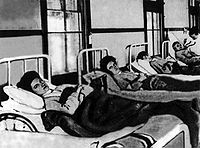
 What about the real person, though? Mary Mallon was born in Ireland to to a mother who'd had typoid fever while pregnant with Mary. Because Mary was the first healthy carrier of pathogens associated with typhoid fever, she has become infamous and synonymous with those who carelessly spread disease.
Born in 1869 in County Cork, Ireland, Mary immigrated to the United States in 1884. From 1900 to 1907 she worked as a cook in the New York City area.

In 1900, she had been working in a house in Mamaroneck, New York, for under two weeks when the residents developed typhoid fever. She moved to Manhattan in 1901, and members of the family for whom she worked developed fevers and diarrhea and the laundress died. She then went to work for a lawyer until seven of the eight household members developed typhoid; Mary spent months helping to care for the people she made sick, but her care further spread the disease through the household. In 1906, she took a position in Oyster Bay, Long Island. Within two weeks, six of eleven family members were hospitalized with typhoid. She changed employment again, and similar occurrences happened in three more households.
 
When typhoid researcher George Soper approached Mallon about her possible role spreading typhoid, she adamantly rejected his request for urine and stool samples. Soper left and later published the report in June, 1907, in the Journal of the American Medical Association. On his next contact with her, he brought a doctor with him, but was turned away again.
 
Mallon's denials that she was a carrier were based in part on the diagnosis of a reputable chemist who had found her to not harbor the bacteria, so perhaps she is not entirely to blame for her doubts. Moreover, when Soper first told her she was a carrier, the concept of a healthy carrier of a pathogen was not commonly known. Further, class prejudice and prejudice towards the Irish were strong in the period, as was the belief that slum-dwelling immigrants were a major cause of epidemics.


Mary Mallon in hosptial quarantine
During a later encounter in the hospital, Soper told Mary that he would write a book about her and give her all the royalties; she angrily rejected his proposal and locked herself in the bathroom until he left.


The New York City Health Department sent Dr. Sara Josephine Baker to talk to Mary, but "by that time she was convinced that the law was only persecuting her when she had done nothing wrong." A few days later, Baker arrived at Mary's workplace with several police officers who took her into custody. The New York City health inspector determined her to be a carrier. Under sections 1169 and 1170 of the Greater New York Charter, Mallon was held in isolation for three years at a clinic located on North Brother Island.


It is believed that individuals can develop typhoid fever after ingesting food or water contaminated during handling by a human carrier. The human carrier is usually a healthy person who has survived a previous episode of typhoid fever yet who continues to shed the associated bacteria, Salmonella typhi, in feces and urine. It takes vigorous scrubbing and thorough disinfection with soap and hot water to remove the bacteria from the hands.


Eventually, the New York State Commissioner of Health, Eugene H. Porter, M.D., decided that disease carriers would no longer be held in isolation. Mallon could be freed if she agreed to abandon working as a cook and to take reasonable steps to prevent transmitting typhoid to others. On February 19, 1910, Mallon agreed that she "was prepared to change her occupation of cook, and would give assurance by affidavit that she would upon her release take such hygienic precautions as would protect those with whom she came in contact, from infection".  She was released from quarantine and returned to the mainland.
 
She had been given a job as a laundress, which paid lower wages, however. Mallon adopted the pseudonym Mary Brown, returned to her previous occupation as a cook, and in 1915 was believed to have infected 25 people, resulting in one death, while working as a cook at New York's Sloane Hospital for Women. This time I have no sympathy for her. Knowing she could infect others, she worked in a hospital! Public-health authorities again found and arrested Mallon, and returned her to quarantine on the island on March 27, 1915.
 
Mallon was confined there for the remainder of her life. She became something of a minor celebrity, and was interviewed by journalists who were forbidden to accept even a glass of water from her. Later, she was allowed to work as a technician in the island's laboratory.


Mary Mallon
On November 11, 1938, aged 69, she died of pneumonia. An autopsy found evidence of live typhoid bacteria in her gallbladder. It is possible that she was born with the infection, as her mother had typhoid fever during her pregnancy. Her body was cremated, and the ashes were buried at Saint Raymond's Cemetery in the Bronx.

Monday, March 7, 2011

HAPPY ANNIVERSARY, TEXAS!


Because I live in Texas and am a Texan, I’m compelled to mention that this past week, March 2nd, was the 175th anniversary of Texas’ Declaration of Independence from Mexico. The Declaration was framed and issued at Washington-on-the-Brazos. At that time, the town was known only as Washington and was a mile southwest of the junction of the Brazos River and Navasota River, seventy miles northwest of Houston. Washington was an important commercial city. Not until after the Civil War did the town become hyphenated to Washington-on-the-Brazos.


The Alamo at night;
do you believe
in ghosts?
Most of my ancestors hadn’t arrived here by then, but I still find pride in being Texan. (Bailey Hardeman, one of the committee who wrote the Declaration, was a way distant relative at 3rd cousin 4 times removed.) I’m certainly glad none of my direct family line fought at the Alamo, even though I respect those men who did, or I might not be here now. Most of my family arrived forty years later when GTT or “Gone To Texas” was a familiar slogan for those hoping for a fresh start.

Sam Houston
Texas'
First President
Many people don’t realize that Texas was once a country, the Republic of Texas. We had our own President, diplomats, embassies, and currency. In fact, seeing the bronze plaque marking the Texas Embassy site in London was a genuine pleasure. (Well, of course it was! I was on a trip to England with my husband. How could it not be fun?) My husband and I even ate at a Tex-Mex restaurant nearby. Fun, even though it was nothing like Tex-Mex back home.


Texas' Lone Star flag
When Texas joined the United States, it was by treaty stating that our flag could be flown side-by-side with that of the United States. Sadly, the first Texas state capitol burned. Our current capitol building in Austin is 7 feet taller than the capitol in Washington D.C. Yes, we just had to build it taller than the one in D.C.!

Whether you live in Texas or not, please help us celebrate our state’s anniversary this year!

Monday, February 7, 2011

LAUDANUM USE IN THE 19TH CENTURY

Laudanum Bottle
would have a cork
in the top
Laudanum is a very old drug, but use became widespread during the Victorian era. Some authors suggest that use was a major health problem. Certainly many notable people of the time were addicted: Lord Byron, Percy Blythe Shelley, John Keats, Charles Dickens, Edgar Allen Poe, William Taylor Coleridge, and Sir Arthur Conan Doyle (as well as his character Sherlock Holmes) are only a few. I confess I’m more than a little surprised that Charles Dickens appears on the list. Before we judge, however, we have to understand the times.

Look in your medicine cabinet. If yours is like mine, you stock pain relievers for headaches and arthritis, coughs, Immodium, allergies, and gas relief. In the 1800’s, mortality from cholera, malaria, and dysentery was very high. Now we only have to take an Immodium tablet or something similar, but diarrhea actually killed huge numbers of people while they suffered terrible cramping. Even if laudanum couldn’t cure them, it eased their pain.

New Rx's
decrease death
rates
Tuberculosis was a problem, made worse by living conditions and hard work necessary for life in those times. Think of the furor when there’s an outbreak of e-coli, but that must have been commonplace in Victorian times and hardly newsworthy.

It’s hard to realize just how deadly these diseases were because we have sanitation that has diminished cholera and dysentery. The drainage of swamp lands decreased malaria, a disease one of my ancestors contracted from living in the Brazos River Valley near Waco, Texas in the 1880’s. Introduction of aspirin in 1899 provided an alternative medication for pain relief. Along with antibiotics, modern pharmaceuticals have diminished the severity of all those diseases.

A century ago, a
sick woman would
have taken
laudanum
I wouldn’t feel comfortable providing the recipe I discovered for making laudanum, but it was 10% opium and 90% alcohol and usually flavored with cinnamon and sometimes also saffran. Not only was it available over the counter, it was recommended by doctors for everything from menstrual cramps to tuberculosis. It was much cheaper than any other form of pain killer, and that made it attractive to those in the lower economic classes. By no means was laudanum used only by the poor. Wealthy women even used it to achieve a coveted pallid complexion, and even infants were spoon fed laudanum. Only later did people realize that laudanum use was habit forming and demanded greater and greater doses to provide relief.

Modern
vaccinations
eliminate formerly
fatal diseases
In 1906, the Pure Food and Drug Act required that certain specified drugs--alcohol, cocaine, heroin, morphine, and cannabis--be accurately labeled with contents and dosage. Previously, many drugs had been sold as patent medicines with secret ingredients or misleading labels. Authorities estimate that sales decreased by one third after labeling was required. The Harrison Narcotics Tax Act of 1914 restricted the manufacture and distribution of opiates, including laudanum, and coca derivatives in the United States. Not until the middle of the 20th century did the U.S. government limit the use of opiates. In 1970, the U.S. adopted the Uniform Controlled Substances Act, which regulated opium tincture (laudanum) as a Schedule II substance and placed tighter controls on the drug.
Caroline Clemmons writes romance and adventures—although her earliest made up adventures featured her saving the West with Roy Rogers. Her career has included stay-at-home mom (her favorite job), newspaper reporter and featured columnist, assistant to the managing editor of a psychology journal, and bookkeeper. She and her husband live in rural North Central Texas with a menagerie of rescued pets. When she’s not writing, she enjoys spending time with family, reading, travel, browsing antique malls and estate sales, and genealogy/family history. Her latest contemporary and historical romance releases include THE TEXAN’S IRISH BRIDE, OUT OF THE BLUE, SNOWFIRES, SAVE YOUR HEART FOR ME to be released March 10th, and the upcoming HOME SWEET TEXAS HOME. Read about her at http://www.carolineclemmons.com/ and http://carolineclemmons.blogspot.com/. She loves to hear from readers at caroline@carolineclemmons.com