Where Romance and History Meet - www.heartsthroughhistory.com/

Pages

Showing posts with label cowboys. Show all posts

Tuesday, September 13, 2011

Man's best friend


Man’s best friend

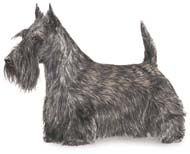
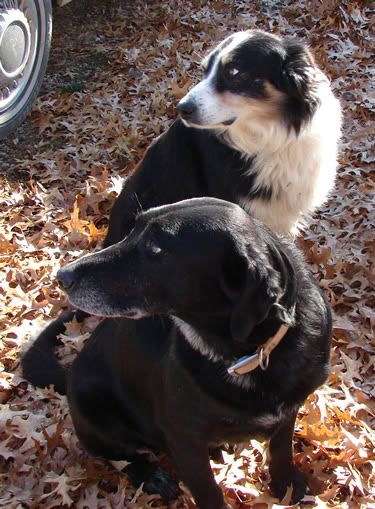
Once our son’s grew up and left home, my husband and I got puppies. So now we do agility with our dogs, a Scottish terrier named Smokey and a Pembroke Welsh corgi named Bandit.


So now I’m thinking about how to incorporate dogs into my stories. Since I write (mostly) in the American west, there are plenty of opportunity to have a dog as a character.


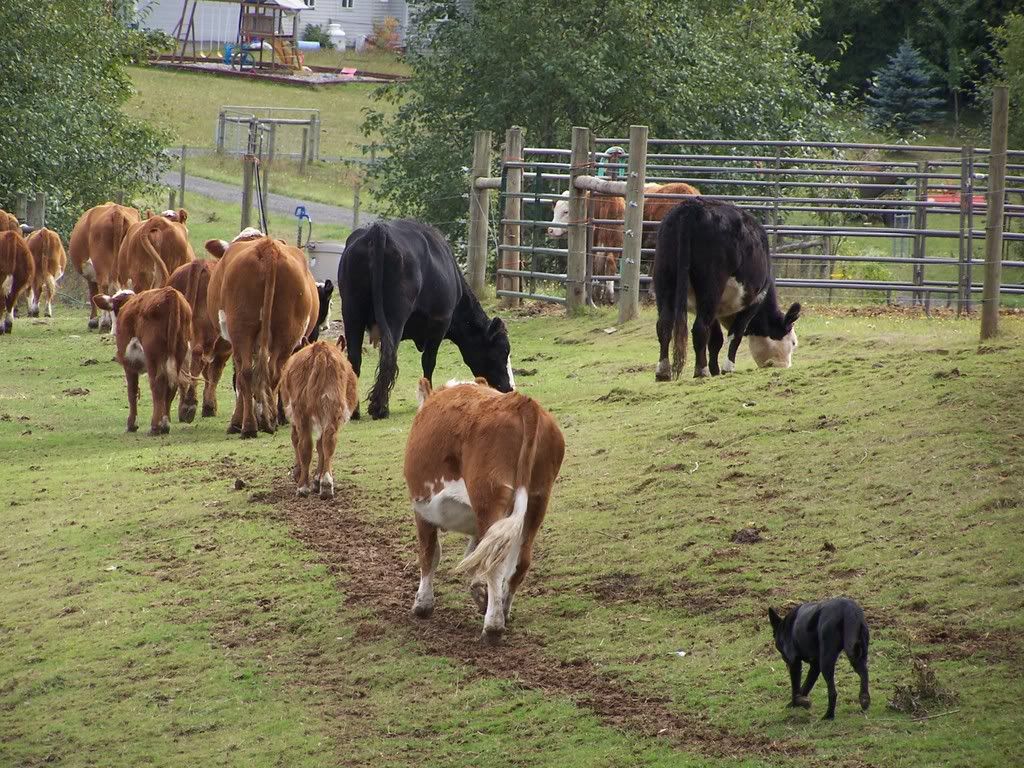
In one story the cowboy hero brings his new wife a puppy. Ranches often had dogs, as they were useful in helping drive cattle. My husband’s family had a dog, Buster, that would help is father round up the cattle. Our Welsh corgi would be over the moon if we had some cows so we could tell him to go get and drive them in for milking.


Dogs were also served to hunt vermin, especially terrier type dogs. Cats get mice, but terriers can get rats. And farmers always have grain to protect.


And, of course, all dogs are watch dogs, who bark when something out of the ordinary happens. I was always impressed by Buster, as if you drove up to my in-laws house in the Oklahoma county side, Buster would bark a warning as you drove up the long driveway. If, however, my in-laws were not at home, Buster would just lay on the porch and give you look like ‘nobody home, silly.’


I would assume that most dogs in the American west were not the purebreds we would see today at a dog show. If a hunting dog had a reputation of being a good hunter, people would want puppies from them. Same with herding dogs, or terriers on their ability.


Finally, one of the most common reason for keeping a dog was for companionship the dog provided.


And while our dogs have the run of our house, I’m pretty sure my heroine who runs a boarding house will only allow the dog in the back kitchen. Our dogs don’t know how good they have it.


Does your family have any dog stories- or do you have dogs in your stories?


Blain’s Smokey of Santee, CGC, NA & Blain’s Sundance Bandit, CGC, NA, NJW

Thursday, July 7, 2011

A Woman Goes Up the Trail

History books would have you believe that only cowboys went “up the trail” on the cattle drives of the late 1800’s. But women went too. Though few in comparison to men, there were more women who made the trip than you might think. And they went as drovers, owners, and just plain cowhands.  One reason I enjoy this period of American history is the many “unconventional-for-the-times” roles western women were allowed to play in the midst of the Victorian Gilded Age.
One of my favorite stories about a woman on the cattle trails is that of Estelle “Amanda” Nite Burks for the very reason she found herself on the dusty, hoof-hardened, dangerous path they called the Chisholm Trail—her husband couldn’t be without her. She relates her adventures in The Trail Drivers of Texas, compiled and edited by J. Marvin Hunter, first released in 1924.
Amanda’s husband, W. F. Burks, missed her from the moment he started on the trail and sent back for her when they were only a few miles out. Amanda went in style as befitting a cattle baron’s wife. She and one of her servants rode in a little buggy “drawn by two good brown ponies.”  Her servant cooked for her and put up her tent in the evenings but, otherwise, Amanda lived like the other cowboys.
Ready to handle anything, Amanda was tested a number of times but her biggest problem seemed to be playing with fire, literally. As she relates it:
“On one occasion a prairie fire ran us out of camp before breakfast. We escaped by fleeing to a part of the plain which had been burned before, called a “a burn’ by people of that section.
Two days later my ignorance was the cause of an immense prairie fire. I thought I would build a fire in a gulley while the cook had gone for water. Not later than I had struck the match than the grass all around was in a blaze which spread so quickly that the men could not stop it. They succeeded in beating out the flanks of the fires so that it did not spread out on the sides at the beginning. The fire blazed higher than a house and went straight ahead for fifty miles or more. Investigators came next day to find out who the culprit was, and when they learned that it was a woman, nothing was said, except for a remark one of the men made that he was glad that he didn’t strike that match.”
Far from being resented by the cowboys who made the trip, she was beloved. Branch Isbell fondly recalls, in the same book, going up the trail with Amanda in attendance. “Being a ‘tenderfoot,’ I was started in at the rear end of the herd and Mrs. Burks took me under her protecting wing. I verily believe that her business success since her widowhood began, has been given her as a reward for unfailing kindness to myself and others.”
She had many notable experiences from fire, to getting lost, to plunging into creeks and avoiding stampedes. But in the spirit of a true Texan, she summed up her adventures, thus:
“I arrived home in much better health than when I left it nine months before.
Please don’t think now that I’ve finished telling the few stories of my trip over the Old Kansas Trail, that the journey was one of trials and hardships. These incidents served to break the monotony of sameness of such a trip.”
She concluded: “For what woman, youthful and full of spirit and the love of living, needs sympathy because of availing herself of the opportunity of being with her husband while at his chosen work in the great out-of-door world?”
After her husband died, Amanda continued to run the cattle ranch, diversifying to sheep ranching and expanding her ranch and buying others until it was one of the largest in her county. She was known as a good rancher and an even better businesswoman. She was elected Queen of the Old Time Trail Driver’s Association in 1924 and was immortalized in Emerson Hough’s fictional book based on her life, North of 36, which became a film and was later remade as The Texans in 1938. Anyone remember that one?
 Some of the film was shot at her ranch, La Motta. She continued to mourn her husband, who she supposedly fell in love with at first sight, for the fifty-one years she outlived him, refusing to wear anything but black or white with only a bit of lavender now and again as an accessory.
Amanda was a woman of spirit and grit but she never forgot she was also a lady.

Anne Carrole writes about cowboys who have grit, integrity and little romance on their mind and the women who love them. You can check out her contemporary romance, Re-ride at the Rodeo, at www.annecarrole.com. She also is co-editor of the review website, www.lovewesternromances.com

Sunday, June 13, 2010


I love Cowboys

As if you didn’t know from reading any of my blogs, I love the American West. The West, along with the American Revolution are part of the defining characteristics of the United States.

While I’m still writing historicals set in the West, I also trying my hand at a contemporary story, set of course in the west, and the hero is a rodeo cowboy.

The modern day rodeo, with it prize money, electronic timers, and PRCA (Professional Rodeo Cowboys Association) had its roots in the everyday work and life of the historic cowboy.

The word rodeo (row – di – o) comes from the Spanish word rodeo (row-day-o) with just a different accent on the syllables, derived from the Spanish verb ‘to surround’ or round up. Naturally the cowboy who was the best at his job had the respect of the other cowboys. And, being competitive, the idea of having a competition to see who was the best at a certain skill was a foregone conclusion. Thus, the rodeo.

Original rodeos were unofficial and often held at the end of a spring or fall roundup. The skills need for the round up were the skills tested in the rodeo. Such skills riding a ‘green broke’ horse that were often used to start a round up cutting a cow out of the herd, or roping cattle for branding.

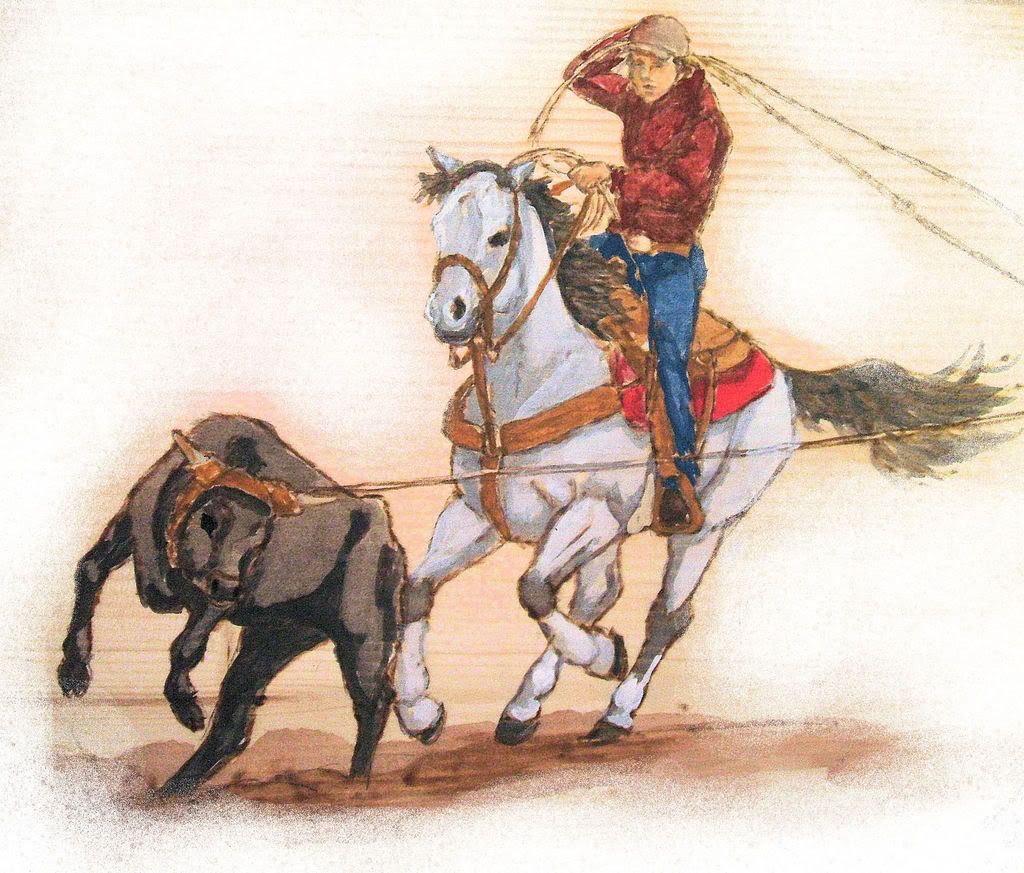
Today the events are bronc riding, both with a saddle and bareback, calf roping, and team roping (where one cowboy ropes the head and the other cowboy the heels of the cow).

Did you know that the actor Ben Johnson, who appeared in many western movies from the 40s to the 70s had been the Steer Roping Champion in 1953?

As the rodeo became more organized and profession events were added that were not actually part of the working cowboys repertoire.


Really, how many cowboy actually jumped off a horse to grab a steer by the horns and wrestle him to the ground (what did they think that rope was for?). Bulldogging, or steer wrestling was ‘invented’ by Bill Pickett, a black cowboy.


Another invented event is bull riding. I can’t help but think one cowboy said to another, ‘yeah, you can ride a bronc, but could you ride a bull?’

One of my bucket list items it to attend the Calgary Stampede or the Cheyenne Frontier Days. Yes, there is nothing like a long, lean man in levis, boots and a cowboy hat. (Sigh)

How about you, are cowboy one of your favorites?

Saturday, February 13, 2010

A Rose By Any Other Name


A Rose By Any Other Name

When starting a story, one of the things I really put thought into is the names of my characters. And when writing a historical, you want to get names that fit your characters as well as give some authenticity to the time period you’re writing.

Always consider the impact of your characters names. Not just any name will do. Why do you thing Marion Morrison changed his name when he became an actor? For example, a friend of mine was writing a contemporary with a heroine who was supposed to be somewhat of a free spirit, unorganized and dressed in lots of bead and flowing skirts. Now there is nothing wrong with this, but she was having trouble making the character work. She had named the character Taylor. As I pointed out to her, the name and its conations did not match the heroine she was trying to create. So once she changed the characters name to something for in line with the actual character she was creating, the story went much better.

(By the way, the name Marion Morrison used when he started acting in cowboy movies was John Wayne.)

In one of my favorite author’s one book has a heroine named Niema. Now, how do I pronounce that (even if it’s only in my head)? Neigh-ma? Knee-I-ma? Nay-ma? And by the time the author gave me the information on how to pronounce it, I’d been doing it wrong, so every time thereafter, I stumbled over this name, having to think if I was reading/pronouncing it correctly.

So if you character has an unusual name, or one where the spelling doesn’t match the pronunciation, be sure to give the reader a clue as to how they pronounce their name as soon a possible. For example, if your medieval heroine’s name is spelled Brighid (after St. Brighid) you have to let your reader know that it’s most to be pronounced as ‘Bride’. This traditional spelling of Brighid has morphed into the modern Brigitte.

If you’re writing historicals you probably won’t want to call your heroine Tiffany. And while the name Mildred is a nice historical name you might not want to use that either as it will not strike the modern reader’s ear with any harmony. So you have to find that nice middle ground where the name is historical, but easy on the modern ear.

Another thing to remember that many names that are given to females today were traditionally and historically male names. Today a person with the name Ashley is most likely female, but just over a hundred years ago it was a man’s name (remember who Scarlett was in love with at the beginning of Gone With the Wind?). The same goes for the names Stacy, Tracy, Courtney, Terry, Leslie, Shirley. Even in England today you can find men named Beverly and Evelyn.

When I start a story, I look at the character’s background and see if there is a clue there for the name. While writing KENTUCKY GREEN, I knew my hero grew up on the Kentucky frontier. I wanted him to have all the skills of a frontiersman (which would be used in the story), and knew that his father was a half-breed. When you think of the Kentucky frontier the name Daniel Boone always comes to mind. And Boone was known for not being prejudiced against Indians. So I made my hero’s father a hunting companion of Daniel Boone, and so, following the fashion of that time, the hero was named after his father’s friend, and became Dan.

I did push my luck with the heroine in KENTUCKY GREEN, as her name is April (the month she was born). But in the story April functions as spring/light that helps rescue Dan from his dark/winter personality.

If you are lucky, your characters will tell you what their name is. When doing brainstorming on the plot and characters, one of the things you can do is a first person biography or interview of your character. I used this technique when working on COLORADO SILVER, COLORADO GOLD for the hero. The hero ‘told’ me “My name is Samuel Jacob Westmoreland. My mother died when I was born and my father never forgave me for it.” So since his father’s name was Sam also, my hero became known a Wes. The origins of his name are vital to the story and how he relates to the heroine.

For my heroine, I wanted to name her Julie, which wasn’t too likely, so I made her father a fan of Shakespeare, and her name is really Juliette, and her sister Cordelia after Shakespeare characters.

In my WIP (work in progress), the hero’s goal is to reclaim the ranch that his family lost when rustlers killed his father. So for his name, I chose Clay which relates to the earth, which is his goal.

Who are some of your favorite characters? Do you like to read stories where the character have your name? Or the hero your brother’s name?

Terry
(and yes, this is my real first name, my dad wouldn’t even spring for Teresa)

Friday, April 24, 2009

Pickin' your hoss.


Cowboys on working cattle ranches had a string of horses they picked for their use while working a ranch. The same horse couldn't be used every day chasing critters and traveling great distances, so they had a string to take care of and use.

A "choosin' match" would be held at the beginning of the season. The foreman had first pick, then the older hands down to the last person hired who had the final choices or what was left.

Taking a horse from a man's string was the same as asking him to quit. A newly hired hand would be given a string without a word being said as to the temperaments. If he was a good cowhand, he'd figure it out. Any cowboy who rode someone else's horse or conspired to cause trouble for another was looking for trouble. If a cowboy quit or was fired his string was kept until a replacement was found and his horses turned over to the new employee.

The boss of the outfit counted the remuda or horses every day and took notice if a horse was being abused in anyway. If a horse showed signs of saddle sores or spur marks, the wrangler was asked to take his private horse and leave.

Most cowboys treated their horses well and bonded with each animal. No one wanted to get stranded on the trail or chasing cows without a horse. The hardest part at the end of the trail ride was having the boss sell their string of horses when the cattle were delivered.

Remudas usually contained geldings. They made the best cow horses. Most authors tend to put their cowboys on stallions but they fought and disturbed the peace of the remudas. And mares were too temperamental and a constant disturbing element.

In the fall when the work was done only a few mounts were kept on the ranch. The rest were turned out on winter range. Before letting them loose, the boss checked their ages, conditions, and feet. Every horse in the remuda had a name and was well-known to the longstanding hands. Their names were usually descriptive of their coloring or attitude.

Roundup work was hard on horses and they were changed three times each twenty-four hours. Horses had specific jobs depending on what they were good at. They had circle horses, cutting horses, rope horses, and night horses.

Circle horse- These were horse used to keep the cattle bunched up as they moved. They had to be strong, fast, agile, and not easily intimidated as they may have to ride into or around a herd of stampeding cattle.

Cutting horses- These were the top-ranking horses in the outfit. They were trained to cut a specific animal from a herd. The cowboy would point the horse at the animal and it would know that's the one to cut out. These horses anticipate every move of the cattle, have speed and quickness to spin and turn faster than a cow. It took a good horseman to ride a good cutting horse.

Rope horses - A good roping horse was a must during branding or just checking the herd. A good roping horse knows the minute the cowboy unhooks the lariat that they are ready for business. He races to the side of the cow selected and maintains the position so the cowboy can throw the loop. If the rope misses the horse drops back, allowing the cowboy to gather his rope and reposition. Once the animal is roped, the horse immediately sits back on his hind quarters and faces the animal keeping the rope tight. A good rope horse never lets the rope slack.

Night horse - The remuda has night horses. These are selected with care. The attributes needed in this horse are: gentleness, sure-footedness, dependability, keen eyesight, and a sense of direction. A night horse can see a single cow straying from the herd at night and turn it back without guidance. The horse could find its way back to the camp on the darkest night. Many cowboys dozing in the saddle while on night duty could be wakened by their horse making a sudden move to return a straying cow. A seasoned night horse also knew when the two hour shift was ending and would alert the rider by pulling on the bit and shaking its head. The horse and not the rider knew what to do during a stampede at night caused by thunder and lightning. The horse raced along the flank of the stampeding cattle. The rider gave his horse his head and depended on the animal's sight and sure-footedness to get them through.

A good horse was as well if not more respected than a good cowboy. The job of raising and moving cattle in the west was an occupation of danger and a good horse helped you survive.

My horse, though not a total cow horse yet, Bud, can be seen on the cover of my book Outlaw in Petticoats. You can view the cover, read an excerpt and reviews, and enter my website contest at: www.patyjager.com

Friday, March 13, 2009

Victorian Christmas -- Western Style

When my editor told me that the launch novel for my upcoming trilogy was to be a Christmas themed story, I was equally excited, and stumped. Snagging a holiday slot was fabulous news, even though it meant a total rewrite of the summer set novel I'd nearly written in keeping with my proposal.

I'd published a Christmas themed short story a couple of years ago, so I had a fair idea how the holdiay was celebrated in Victorian America, but I was stumped on how the Old West ranchers truly celebrated Christmas. Face it, it would be nearly impossible or impractical to brave blizzards and go caroling door to door, as your nearest neighbor could be miles away.

Decorating Christmas trees had gotten a foothold in Europe in the early 1800s, and that tradition was brought to America.

Though blown glass ornaments had been used to decorate Christmas trees in late 1870s Germany, they didn't become vogue in America until the 1890s. The glass ornaments were handpainted and decorated with twisted wire and tinsel, reflecting the time. Jockies on horses, sail boats, trumpets, globes, bells and baskets -- just to name a few.

Nuremberg angels, with their spun-glass wings and gold and silver crinkled skirts, were much sought after. Ornaments imported from Dresden, Germany were another hugely popular decoration, being made between 1880 and 1910. These pressed cardboard designs were extremely realistic, and either gilded, silvered, or handpainted.

Electric Christmas lights were invented in the late 1880s, but many people still used tiny candles on trees, either because they lived in isolated regions were electricty hadn't reached, or they were poor.

For those without the financial means to deck the tree in the new Victorian fashion, they relied on what they had at hand. Popcorn and berry garlands, or paper strings were used to drape a tree. Yarn dolls, gingerbread men, and lacy sachets hung from the boughs. Cornhusk angels often perched atop the tree.

The children hung their stocking by the fire, in hopes that St. Nick would leave candy and a toy, and maybe a shiny new penny inside.

For those living on ranches in the West, they did their caroling around the Christmas tree. Their gifts were mainly handmade items that were desperately needed.

Christmas Day dinner was as much a feast as could be had, with the ranch family and the workers gathered together to share the bounty. If they could afford it, they'd order a turkey or ham from the mercantile in town. Some imported fresh fruit, only to have it arrive frozen. Many baked desserts far in advance, from pies to cakes to traditional plum puddings.

One thing remained the same for those living in the city or country. By and large they viewed Christmas as a special day of sharing and reflecting.

I enjoyed doing research on Victorian Christmas traditions for my October '09 release, A Cowboy Christmas. My heroine adored Christmas and all it meant, and my hero had never celebrated the holiday in his life. I hope to have an excerpt up on my website soon.

What's your favorite Christmas tradition? Comment for a chance to win a copy of my Christmas short story, Christmas Showdown.