Where Romance and History Meet - www.heartsthroughhistory.com/

Pages

Saturday, September 24, 2011

Idaho Hotel-Silver City

Backside of the hotel and other buildings
When Lauri Robinson approached me about writing a “sisters” book together I jumped on the idea. As we chatted back and forth establishing their background and how the story would end we needed a town that the family would be traveling to at the start of the book. Preferably a mining town between where your two sisters would end up.

Tink on the Idaho Hotel porch
After some digging I came up with Silver City, Idaho. It was up and running in the time frame we needed. A discovery of gold on War Eagle Mountain in 1865 started the influx of miners and merchants. The failure of the Bank of California, which funded most of the mines, caused the mines to stop work in 1875. But some carried on until and there was a short revival in 1890. Mining didn't come to a complete shut down but irrigation and agriculture increased in the lower valley around the Snake River and the mountain towns dwindled.

Only a few people remain in Silver City today and mostly during the summer because the road to the mountain town is closed by snow from October to May.

When Lauri and I decided on using this town in our book, Tink(my dog) and I took a road trip to see how the stage coaches approached the town and what it looked like in the small valley near the top of the mountain.

old stamp mill
There are still some original buildings. The one that impressed me the most was The Idaho Hotel. It has a welcoming wide front porch that spans fifty-eight feet, it's three stories tall, and has beautiful woodwork inside. The current owners are restoring it to its original condition.

When it was built it was considered one of the best hotels in the Idaho Territory. It boasted a large dining room, kitchen, fifty guest rooms and a beautiful mahogany bar. It had a bath house and the backside is up against Jordan Creek. That back area was a Chinese laundry. Running water was piped into the hotel in 1869 and in 1878 the owner built an electric plant on Jordan Creek to illuminate the hotel and other businesses.

In 1871 a bar and additional rooms were added onto the east end. On July 4th in 1873 the townsfolk shot off a cannon in celebration and chattered a third of the window glass in the hotel. This gave the owners the nudge to remodel. The enlarged and improved by adding a woodshed, a large kitchen and two rooms over the barroom. In 1874 they add the costliest and handsomest mirror to ever travel to Silver City in the bar.

The hotel was also the depot for all the stage and express lines.

For a Sister's Love blurb:

Lorelei and Maggie Holmes make a desperate vow to reunite after an Indian raid on their wagon train leaves them orphans. Eight-year-old Lorelei is taken in by an impoverished family headed to a Colorado mining town and ten-year-old Maggie finds herself on the way to Portland, Oregon to live with a woman widowed during the Indian attack.

Ten years later, Lorelei’s adoptive father gambles away her birth mother’s locket and her only connection to her lost sister. Believing she needs the locket and to find Maggie, she sets out after the gambler and ends up in the company of a citified lawyer searching for the same man.

While cleaning a hotel room, Maggie discovers her mother’s locket in the possession of a gambler. Fear for her sister increases Maggie's determination. Never one to give up, she dogs the gambler until he agrees to help her find her sister.

Two sisters, two adventures, will they find one another or will the men helping them be their destinies?

This book is available at Kindle, Smashwords, and Nook for $.99

Paty

http://www.patyjager.net/

http://www.patyjager.blogspot.com/

Friday, September 23, 2011

Alexandra: The Early Years

By Emma Westport


In June 1884, Princess Alix, from the small duchy of Hesse and by Rhine, came to St. Petersburg to celebrate the marriage of her sister, Ella, to the Tsar’s brother, the Grand Duke Serge.    The young girl was related to most of the nobility of Europe, many of whom she’d never met and all of whom were in attendance.  At a family dinner, she found herself seated next to her handsome, blue-eyed cousin, the sixteen-year-old Tsarevich, Nicholas Romanov.  Before dinner was over, Alix was in love.  So was he.  That night, Nicholas wrote in his diary.  “I sat next to little twelve year old Alix and I like her awfully much.” 

For the rest of her stay, Alix spent time with her cousin.  They walked in the parks around Peterhof, laughed together and etched their names in the window of the Italian House.  Nicholas gave her a brooch, which she at first accepted.  But before she left, she gave it back feeling, perhaps, she was too young for such an expensive gift.    

By the time Alix returned to Russia in 1889, it was clear to both families that there was something more than a childish infatuation at play.  The formidable Queen Victoria opposed the match.  She liked Nicholas well enough.  She thought him a charming young man.  But she did not want to see a favorite grandchild on the dangerous throne of Russia.  Nicholas’s grandfather had been brutally murdered by an assassin’s bomb and his father Tsar Alexander III had also been the target of assassination attempts.  No.  Victoria pressed Alix to marry ‘Eddy,’ eldest son of the Prince of Wales.  Victoria believed Alix would be a steadying influence on the young man and she wanted Alix to be Queen of England.  Alix refused the match.

Tsar Alexander III and his wife also opposed a marriage.  The Tsar felt Nicholas was already too timid.  He did not want to see his son married to a wife with the same failing.  Worse, Alix often hid her shyness behind a cold smile and curt manner.  The Tsarina, Maria Feodorovna, feared this would make Alix unpopular.  She would never be loved or accepted by the Russian people.

Thing changed when the Tsar became ill.  The prospect of his own death made the Tsar realize Nicholas needed someone by his side.   Queen Victoria continued to oppose their marriage but Nicholas now had his parents’ permission to at least court Alix.  Aided by Alix’s sister, Ella, wife of Grand Duke Serge, Nicholas began writing to her.

It did not go well.  Both wanted to marry but marriage to the Tsarevich would make Alix Russia’s Tsarevna and that meant she had to be a member of the Russian Orthodox Church.  Alix could not bring herself to renounce her Lutheran beliefs, not even for the man she loved.  Nicholas was stunned but Ella told him not to worry.  A solution would be found.   And it was.  Alix was told both churches held many beliefs in common.  No ‘renunciation’ was necessary.  She would simply join the Orthodox Church.   Alix accepted Nicholas and their engagement was announced.

The happy couple had a short time together before Nicholas had to return to Russia.  Alix went to England but, even as she traveled, she was followed by reporters and gawkers.  Everyone wanted a glimpse of the beautiful girl who would rule the Russian Empire.  She went to Harrogate under an assumed name, seeking privacy and treatment for the sciatica that would plague her throughout her life.  Her identity was soon discovered.  She wrote to Nicholas, and joked about the people who stared at her.  Next time, she said, she’d know to stick her tongue out at them. 

In fact, her new celebrity frightened the shy Princess.  Total strangers tried to peer in her windows, some using opera glasses.  She couldn’t go out her front door or take a carriage without being followed.  Shopping became impossible.  Any store she entered was instantly mobbed and it was not just the loss of privacy that made her uneasy.  Pain crippled her legs, limiting her mobility and confining her to a wheelchair.  There was no way she could escape if a crowd proved unruly.

Meanwhile, the Tsar’s condition worsened.  Nicholas telegraphed Alix, asking her to come.  Alexander III insisted on getting up from his bed to meet his future daughter-in-law and nothing but his full dress uniform would do.  But the man who used to bend steel bars to amuse his children was exhausted by the effort of standing and putting it on.  Barely able to breathe, he met Alix sitting down.  She came in and knelt before him.

The Tsar died on November 1, 1894.  After the state funeral, Nicholas took advantage of his mother’s birthday, a day when mourning was suspended, to marry Alix.  On November 26, 1894, the twenty two year old Princess became Her Imperial Majesty, Tsarina of all the Russias, Alexandra Feodorovna.   On the morning after her wedding night Alexandra wrote in her husband’s diary.  “Never did I believe there could be such utter happiness in the world, such a feeling unity between two mortal beings.  I love you—those three words have my life in them.” 

It was the start of one of the most tragic love affairs in history.

(For photos and images of Alexandra, please try the following links.  If they do not work, simply cut and paste them in your browser. 

http://www.youtube.com/watch?v=9AgB8bIAYv0&feature=related

http:/youtube.com/watch?v=daUg0KVbxE0

The quote above is from Greg King’s biography, The Last Empress:  The Life and Times of Alexandra Feodorovna, Tsarina of Russia.  Carolyn Erickson’s Alexandra, The Last Tsarina is also very readable.)


Thursday, September 22, 2011

Historical Inaccuracies

One of the things I love most about writing historicals is the research, but it can also be the most irritating task. I have spent that last few months researching words, Kansas orphan laws, screen doors, cellars, stone houses, barb wire, Pinkerton Detectives, coal mines, railways and trains. Of course, I'm sure there are plenty more that I can't think of right now, like clothing, roofing and horses. Oh, I even researched dates for hymnals.

And wouldn't you know it that I didn't even consider whether or not peaches were in season during the manuscript I just submitted. Of course, this little tidbit didn't dawn on me until  a discussion occurred on one of my writer's loops, which brought up another fact that I had failed to research . . .

which Bible translation to use in my historical. I've never read anything other than New International. Who knew that the NIV didn't come into existence until the late 1960s? Certainly not me. Boy, was I embarrassed. But I have been assured by at least one person that my little faux pas won't cause the historically-accurate, lynching mob after me. 

So, have you ever discovered an inaccuracy after the fact? If so, what was it? What kinds of historical inaccuracies in books drive you absolutely nuts?

Happy Thursday,

Christina

Tuesday, September 20, 2011

THINGS THAT GO BUMP IN THE NIGHT...

“From ghoulies and ghosties

And long-leggedy beasties

And things that go bump in the night,

Good Lord, deliver us!”

Traditional Scottish Prayer

After watching this year’s Emmy Show I was surprised with how out of touch I have been with network television. I do have a few guilty pleasures on the small screen especially now as the days grow shorter and the weather becomes crisp with the promise of snow in the air. Two favorite shows of guilty pleasure are the Science Fiction channel’s GHOST HUNTERS and GHOST HUNTERS INTERNATIONAL. I tell myself I am only watching for ideas for paranormal plots but the truth is I want to believe there is tangible evidence of the paranormal. Though I have no supernatural abilities myself I do remember when I was 7 my father turning white at my brother’s christening party and my mother being scared. I later learned, while in the kitchen getting ice my dad was confronted by his mother, except my grandmother had just died two short weeks before. Seems she had come back to see that my baby brother and my family were fine before she could pass over.

On my first visit to Scotland back in 1994 I had planned to visit Roslyn Chapel near Edinburgh after reading THE SWORD AND THE GRAIL by Andrew Sinclair. I was fascinated with the then belief of the chapel’s connection to the Knights Templar and the Holy Grail. After at least a week of tromping through graveyards looking for lost ancestors my husband willingly agreed going the Chapel would a nice change of pace. Unfortunately it didn’t turn out that way for my husband. We entered the Chapel and I was hit was a major sensory overload as to where to look, but after a while I realized my husband was nowhere to be found. I walked outside to find him smoking, weird because he had given it up years before. I asked him to come back in, as I wanted to show him the death mask of Robert Bruce but he refused. I could see he was upset so thinking I could come back later for a church service we left. Finally that night he admitted that he felt while in the chapel as he if he was being chocked and pushed to a dark corner of the chapel. He didn’t get relief until he left the chapel. Since then, I have returned four more times over the years, but he has flatly refused to not only to go in the chapel but refuse to enter the grounds.

Scotland rich in Celtic legends of fairy folk, brownies, kelpies, and witches is a vortex for all kinds of paranormal activities from ghost sightings, to hauntings, to Nessie and even UFO’s (Scotland has more sightings than anywhere in the world). As we approach the final month of the Celtic calendar I wanted to share two of my favorite haunted places in Scotland:

“Bluidy Mackingie, come oot if you daur, left the sneck and draw the bar.”


Greyfairs Kirkyard and the Covenanters Prison:

I first visited here in 1994 on my first trip. Having been raised on all the old Walt Disney movies of the 60’s I had to see where the famous Greyfrairs Bobby was buried. For those of you who don’t know about this wonderful dog, when his owner died he would sneak into the Kirkyard and lay upon his owner’s grave. He was chased off daily but because of his unique loyalty to his owner even in death, he was cared for by the community and allowed to visit his master until he too died. In great Disney fashion, Bobby was buried near his master and the children of the US pooled their money to have a special monument erected for just for Bobby. At the time I first visited one couldwalk the grounds even in the grounds of the Covenanters Prison (17th century), which was turned into a graveyard.


However, all that changed in 1999. As the story goes a vagrant had somehow gotten into the Kirkyard, which was normally locked in the evening. Thinking to find a warm place to bed down for the night he entered George Mackenzie’s Tomb.

George Mackenzie, or “Bluidy Mackenzie” as he was later known, was Scotland’s chief Advocate for King Charles II and it was he who had over 1200 Covenanter prisoners (men, women and children) brought to Edinburgh and imprisoned in the field which is now the Kirkyard. Of the 1200 within 5 months of living out in the open, exposed to the Scottish weather only 257 remained alive. It is noted that Mackenzie took great pleasure in hanging and torturing the Covenanters hence his name.

Unfortunately while in the tomb, the vagrant fell through a floor in the tomb and landed on a mass grave of moldy bones, which were later determined to be plague victims. Scared out of his wits the man fled the tomb scaring the night watchman who heard the commotion. It was later learned that the vagrant had opened one of the caskets in the tomb probably looking for grave goods and in doing so it is believed he unleashed the spirit of Mackenzie. From 1999 forward over 400 members of the public have been attacked while on the Prison grounds. These attacks have included pushing, poking that left bruises and scratches, being knocked down and even knocked unconscious. Most of the attacks occur in or near the Black Mausoleum, which was once part of the prison but it is believed that these are the actions of the poltergeist of Mackenzie. The attacks have become so frequent that the Edinburgh Council has locked the Prison to visitors and is only opened for organized tours, which are not open to those with heart conditions or who are pregnant, those who are most often attacked. The mausoleum has been exorcized twice and one of exorcists died of a heart attack only two weeks after he performed the exorcism.


Hermitage Keep at Newcastleton, Scottish Borders... “SOD Off IN STONE”

The ruins of the Keep are a stark reminder of the type of stone keeps that scattered the Borders of Scotland from the 12th thru the 17th century Scotland. Though on the outside the keep seems to be in excellent condition, the interior has all but been destroyed by Border warfare and the elements. A keep or castle has been on the spot since the early 1200’s and the occupiers have been both Scottish and English, depending on the ebb and flow of warfare on the Anglo/Scottish Borders.


I visited the Keep in 2007 because the third book in my Scottish trilogy is plotted here. If you remember my post on Black Agnes last month you might remember that the siege at Dunbar was saved by Sir Alexander Ramsay and Hermitage is where he met his demise. In 1338, Sir William Douglas of Liddesdale captured the keep from the English commander Ralph de Neville and the Douglas family took control of the keep and surrounding area. However, King David II had decided to reward Sir Alex Ramsay by naming him sheriff of Teviotdale including Hermitage. Enraged by the slight from his King, Douglas lured Ramsay to the Keep where he threw him in the dungeon, which was a dank place with no air or sunlight and eventually starved him to death. Some of the ghostly sounds heard by visitors to the Keep are believed to be that of Ramsay as he attempts to claw himself out of the dungeon. Douglas was later named sheriff and suffered no penalty in Ramsay’s death. But Alexander isn’t the only ghost.

From 1274-1328 the keep was held by one Sir William de Soulis, who was reputed to be a practitioner of the black arts and was able to conjure up his familiar on Robin Redcap to do his dirty work. Soulis was said to have lured young children of the district and used their blood in his horrific rituals. The community was so fed up with the knight that they petitioned King Robert Bruce to remove him from the Keep, but Bruce tired of their complaints replied…

“ Boil him if you must, but let me hear no more of him.”

The people did just as the king wished; they captured him, wrapped de Soulis in lead and placed him head first in a boiling cauldron and kept him there until he died. Many visitors today believe that when they here the sobbing of young children while in the Keep the ghost of Solis is nearby.


And finally, for those of you who are into the Vampire Diaries, True Blood or the Twilight saga you won’t be disappointed to hear that Scotland has vampires too. Though I’m not a fan of vampire fiction I was surprised to learn that a vampire was sighted in the area around Lochmaben in Dumfries in recent years. Lochmaben once a keep of the Bruce family was the sight of a curse levied upon the Bruce family. In the 1200’s the Bruces were forced to move from Annan to Lochmaben because of a flood. The story is told of a visit by the Irish monk, St. Malachy who asked Lord Bruce to spare a thief from a hanging. Bruce complied or so the monk thought but as he passed by Lochmaben he saw the same thief hanging dead and placed a curse on the Bruce family. A curse that was taken seriously as they dedicated land in Annan with its rents went to pay for the upkeep of the shrine of St Malachy at the Cistercian house at Clairvaux. However, the area was to suffer from the plague in later years and many believe the vampire is a result of the curse and plague. The vampire seen in recent years is dressed like a monk but they know he is present when they find dead animal carcasses devoid of blood. The Scottish Ghost hunter Tom Roberston, has encountered the vampire at Lochmaben and has photos of the vampire in his book GHOST HUNTER: ADVENTURES IN THE AFTER LIFE. For everyone who leaves a comment today you will have a chance to win a copy of his book.

But remember the words of Scottish writer J M Barrie..."A house is never still in darkness to those who listen intently; there is a whispering in distant chambers, an unearthly hand presses the snib of the window, the latch rises. Ghosts were created when the first man awoke in the night. "

Monday, September 19, 2011

This week in History

by Anna Kathryn Lanier
I usually wait until the last minute to do my blog. This week has been hectic, because my mother was hospitalized with pneumonia, so I let the blog get even further away from me.  

Anyway, as I need to slap something together for today, I turned to a new book I got a few weeks ago, “365 Great Stories From History For Every Day of the Year.” Anyone who reads my blog knows about this book, as I’ve used it a couple of times for recent blogs. It has a ‘what happened today’ in the past for every day of the year.  I looked at the stuff that happened in the next few days….my gosh.  What was I doing during history class? How did I miss this stuff?

Today, September 19, 1356, Edward, The Black Prince of England defeated King Jean II of France in one of the early battles of the 100 Year War and took Jean prisoner for four years. (Edward is pictured left)

September 20th, the start of the Great Papal Schism began when a group of Cardinals, irritated at Pope Urban VI, who went back on his promise to move the Papal back to Avigon from Rome, held a conclave on September 20, 1378 and elected their own pope, Robert of Geneva, who named himself Pope Clement VII.  The schism lasted 38 years and 309 days and through several anti-popes, sometimes with 3 or 4 different people claiming to be the pope at the same time.  On July 26, 1417, Martin V became the sole Pope when the Council of Constance deposed of one of the pretenders, Benedict XIII. 

September 21, 490 b.c. is something about the Greeks annihilating the Persians at Marathon. Yes, you can see, I’m not particularly interested in that, so, please, look it up yourself at The ORB: On-line Reference Book for Medieval Studies  Just scroll down a bit to The Battle of Marathon – Preparations. 


September 22nd, “The most barbarous royal murder in history.”  Frankly, I think it’s one of the most barbaric ever…royal or otherwise. Warning: This is graphic, so skip to the next entry if you’re squeamish.  Queen Isabella of England wasn’t too fond of her wimpish husband, King Edward II (pictured right). 365 Great Stories From History says he was “handsome, silly, weak and dominated by male favourites.” Isabella and her lover, Roger de Mortimer overthrew him and exiled him to Berkeley Castle in Gloucestershire.  They placed the king in a small, cold cell and fed him scraps, hoping he’d just shrivel up and die.  But Edward was stronger than they thought and he did not decline as they’d hope.  So, on the night of September 21, 1327, three of the queen’s henchmen entered his cell and held him down on his bed. They then “thrust a red-hot spit up through his anus, burning his internal organs.”  Okay, they may not have liked the man, but really, couldn’t they have just poisoned him?  At the time of his death, his son was 14.  Isabella served as regent until Edward III was of age, three years later.  He, unlike his father, wasn’t a wimp.  He sent his mother into exile and, as a traitor to the crown, had Mortimer hung, drawn and quartered. Okay, that may be just as barbaric and what they did to Edward II, but at least Mortimer deserved it!  Oh, btw, Edward II is the young prince depicted in BRAVEHEART, the one who's lover is thrown out the window by his father, Edward I.  Geez, Isabella seems much nicer in that movie!

Also on September 22, 1692, six women and one man was hung in Salem, Massachusetts as witches.

September 23, 480 b.c. ….um, the Greeks knocked the snot out of the Persians again, this time in Salamis. Find out more at the same website as above, The ORB: On-line Reference Book for Medieval Studies. Just scroll down to The Battle of Salamis.

 Okay, these are a few tidbits of history for the coming week. Do you have any you’d like to share with us?
 BTW, my mom should be fine. They have isolated the germ causing the illness and are giving her antibiotics.

Anna Kathryn Lanier

Contest Survey - Please Help

PERMISSION TO SHARE GIVEN AND ENCOURAGED

To improve its annual Romance Through The Ages (RTTA) contest, the Hearts Through History chapter of RWA is asking for your opinion of contests in general, and the RTTA in particular. Please go to http://www.surveymonkey.com/s/ZQ35NVC to take our short survey and be entered for a chance to win a free online workshop from Hearts Through History.


Sunday, September 18, 2011

My Impressions of Berg Nanstein, A Knight's Castle


For some historical romance novels, we authors place our heroes and heroines in castles. Just the word castle conjures up images of wealth and opulence. Those images are further enhanced by novels and movies. So I was delighted when I had the opportunity to visit Landstuhl Germany’s Berg Nanstein in person this summer. I wanted to discover the reality of living conditions for a medieval knight and his lady.

From my study of English castles, I knew were built as military structures to protect landed estates and offer a safe haven in time of war. Berg Nanstein was no exception. Begun in the middle twelfth century, Berg Nenstein reflected the aspirations of ambitious knights. The castle served many functions for its various lords. The castle was the lord’s living quarters along with his administrative, economic and court center. It also acted as a school, archive, treasury, arsenal, and if the castle contained a chapel a sacral function. But most importantly, it was an instrument of war – a place to launch war from, and a retreat or safe haven when war turned against the lord.

This castle is one of five castles built around Emperor Frederic Barbarossa’s Kaiserslautern administrative center. It guarded a strategic and important East-West trade crossing. This castle was a typical fortress built on a hilltop with an elongated tongue of walls that ran down the hillside to surround the city below.

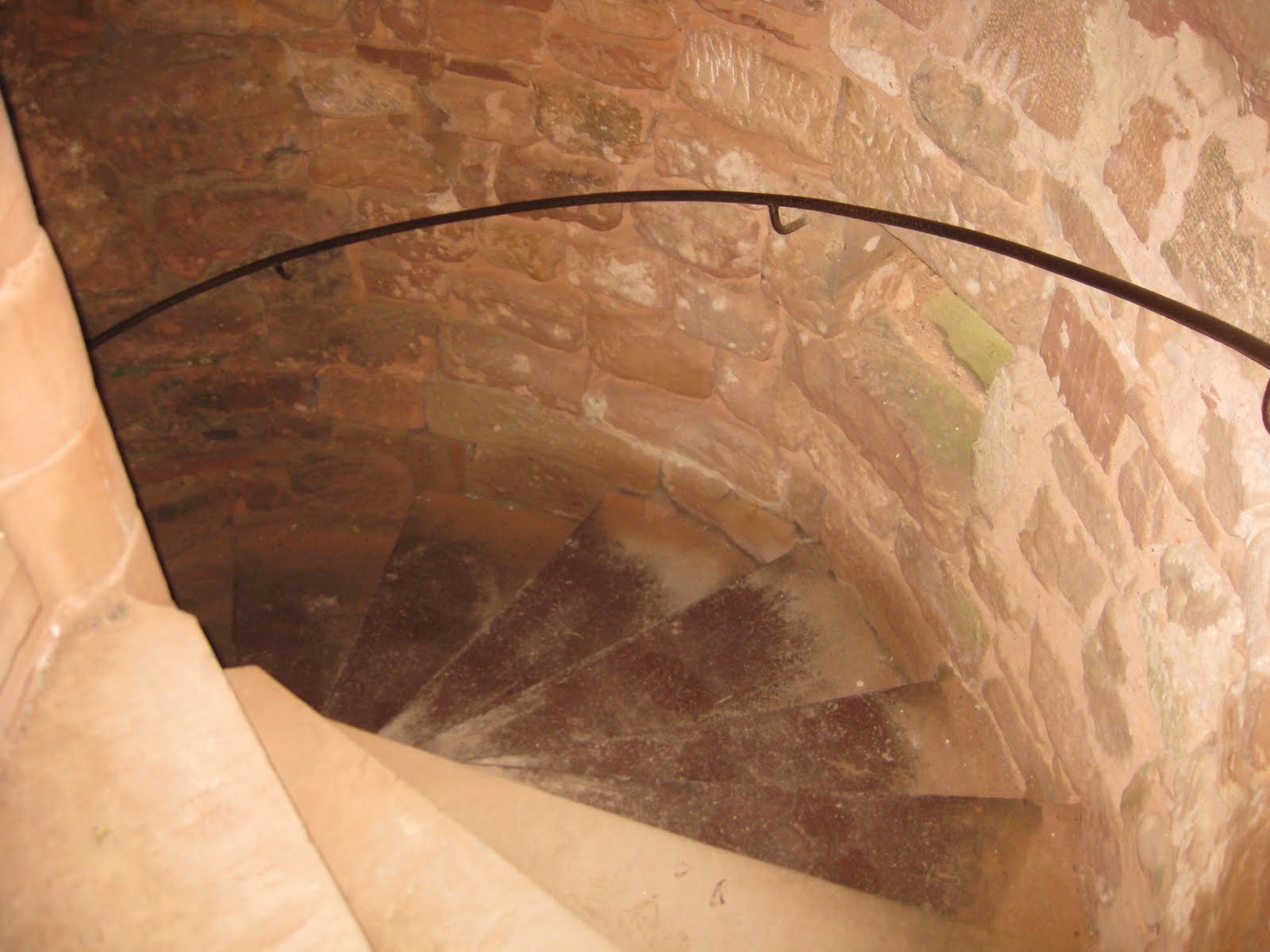
When I walked the grounds around the German castle, I was impressed by the fifteen foot high walls with slits for weapons to be fired. Berg Nenstein, the knight’s strong house, was set on a mountain overlooking Laundstuhl. The sheer drop off to the town as well as its moat and imposing wall would have discouraged most enemies in the twelfth century. But when I wound my way up tight cramped spiral staircases to the top of the towers, I was surprised by the view. Berg Nanstein wasn't situated on the highest point around. That fact caused its defeat in 1523. Enemy cannons mounted on three surrounding peaks situated higher than the castle. The sturdy stone walls were no match for the bombardment, and the castle was destroyed. The castle’s surrender in 1523 during the Imperial Knight War marked the end of medieval castles' usefulness against the modern cannon.

Within the castle walls on top of the hill, all personnel and animals (war horses and hunting dogs) lived on the first floor in areas that resembled a tunnel opening into a large dark holding room with a fire pit at the end. The only private chamber belonged to the lord. All other living accommodations were communal. Public or reception rooms were located on the second floor.

What little light entered any room came from a gun chamber from which castle soldiers shot at the advancing enemy. Weapons were stored along the walls at the ready. All stairs exposed a person’s right side to a lethal rain of arrows from above. (Most fighter were right handed and held shields in their left hands making left spiraling staircases highly effective.)

Although carvings of the knight’s crest adorned the entry arch, the interior of the castle was sparsely furnished with small chairs or wooden block, trunks for mobile possessions, niches in the walls to hold personal objects, a stone hearth, a castle well and fountain. Ulrich von Hutten, a contemporary of the lord who surrendered the castle in 1523, described life in the castle as “not built for the comfort but for battle, inside of depressive narrowness squeezed together with cattle and horse stables, dark chambers and war equipment. The smell of gunpowder everywhere, the odor of the dogs and their excrement is not much more pleasant either.”

Unfortunately, my camera wasn't good enough to capture the interiors of the castle with any clarity. Needless to say, Berg Nanstein wasn't anything like the fairytale castles seen in the movies.

Margaret Breashears
www.wantedghostbustingbride.com