Where Romance and History Meet - www.heartsthroughhistory.com/

Pages

Showing posts with label medieval castles. Show all posts

Sunday, September 18, 2011

My Impressions of Berg Nanstein, A Knight's Castle


For some historical romance novels, we authors place our heroes and heroines in castles. Just the word castle conjures up images of wealth and opulence. Those images are further enhanced by novels and movies. So I was delighted when I had the opportunity to visit Landstuhl Germany’s Berg Nanstein in person this summer. I wanted to discover the reality of living conditions for a medieval knight and his lady.

From my study of English castles, I knew were built as military structures to protect landed estates and offer a safe haven in time of war. Berg Nanstein was no exception. Begun in the middle twelfth century, Berg Nenstein reflected the aspirations of ambitious knights. The castle served many functions for its various lords. The castle was the lord’s living quarters along with his administrative, economic and court center. It also acted as a school, archive, treasury, arsenal, and if the castle contained a chapel a sacral function. But most importantly, it was an instrument of war – a place to launch war from, and a retreat or safe haven when war turned against the lord.

This castle is one of five castles built around Emperor Frederic Barbarossa’s Kaiserslautern administrative center. It guarded a strategic and important East-West trade crossing. This castle was a typical fortress built on a hilltop with an elongated tongue of walls that ran down the hillside to surround the city below.

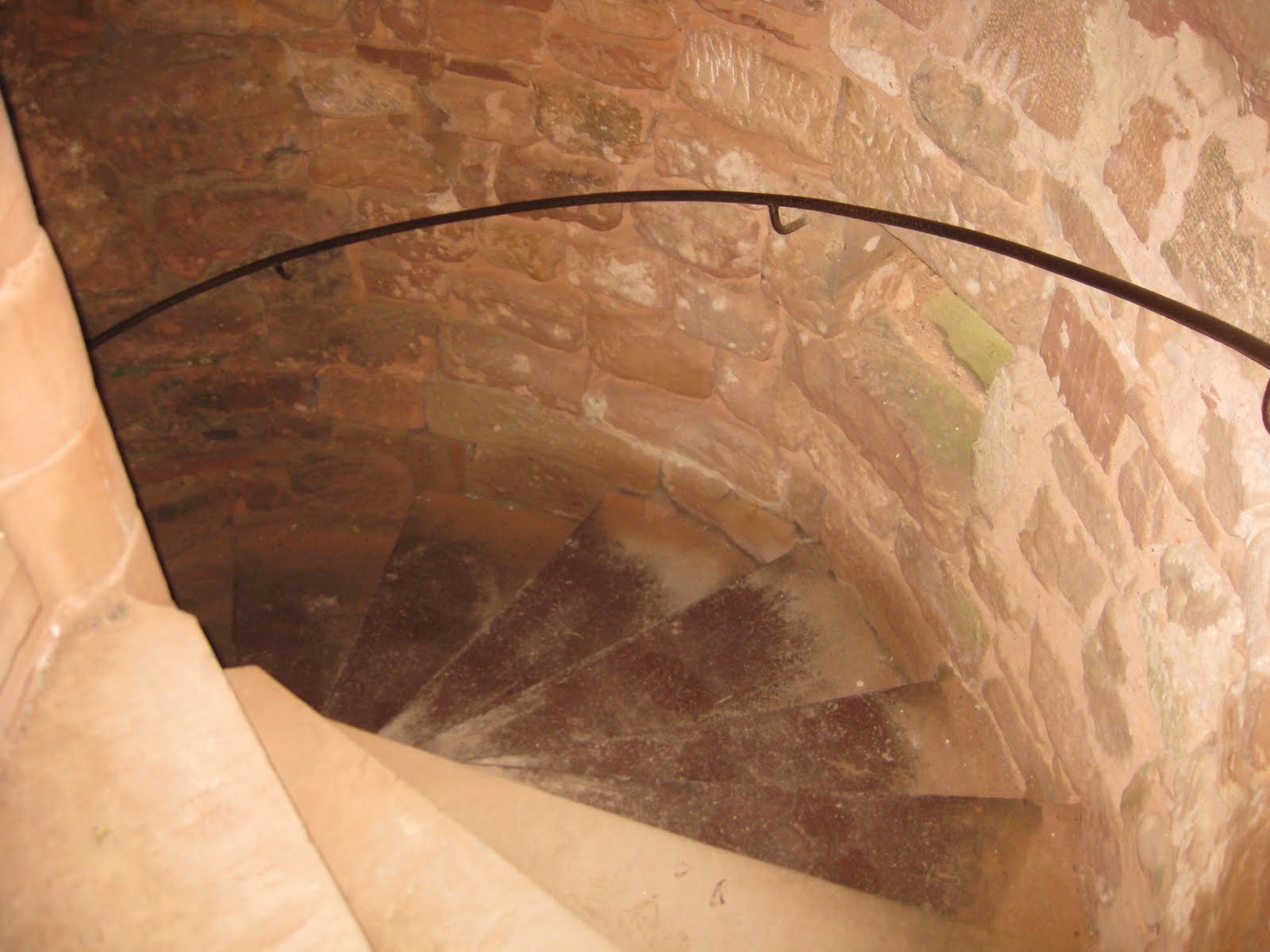
When I walked the grounds around the German castle, I was impressed by the fifteen foot high walls with slits for weapons to be fired. Berg Nenstein, the knight’s strong house, was set on a mountain overlooking Laundstuhl. The sheer drop off to the town as well as its moat and imposing wall would have discouraged most enemies in the twelfth century. But when I wound my way up tight cramped spiral staircases to the top of the towers, I was surprised by the view. Berg Nanstein wasn't situated on the highest point around. That fact caused its defeat in 1523. Enemy cannons mounted on three surrounding peaks situated higher than the castle. The sturdy stone walls were no match for the bombardment, and the castle was destroyed. The castle’s surrender in 1523 during the Imperial Knight War marked the end of medieval castles' usefulness against the modern cannon.

Within the castle walls on top of the hill, all personnel and animals (war horses and hunting dogs) lived on the first floor in areas that resembled a tunnel opening into a large dark holding room with a fire pit at the end. The only private chamber belonged to the lord. All other living accommodations were communal. Public or reception rooms were located on the second floor.

What little light entered any room came from a gun chamber from which castle soldiers shot at the advancing enemy. Weapons were stored along the walls at the ready. All stairs exposed a person’s right side to a lethal rain of arrows from above. (Most fighter were right handed and held shields in their left hands making left spiraling staircases highly effective.)

Although carvings of the knight’s crest adorned the entry arch, the interior of the castle was sparsely furnished with small chairs or wooden block, trunks for mobile possessions, niches in the walls to hold personal objects, a stone hearth, a castle well and fountain. Ulrich von Hutten, a contemporary of the lord who surrendered the castle in 1523, described life in the castle as “not built for the comfort but for battle, inside of depressive narrowness squeezed together with cattle and horse stables, dark chambers and war equipment. The smell of gunpowder everywhere, the odor of the dogs and their excrement is not much more pleasant either.”

Unfortunately, my camera wasn't good enough to capture the interiors of the castle with any clarity. Needless to say, Berg Nanstein wasn't anything like the fairytale castles seen in the movies.

Margaret Breashears
www.wantedghostbustingbride.com


Friday, September 18, 2009

Settings that Inspire Stories


By Michelle Willingham

When I was growing up, some of my favorite historical romances were medievals. I devoured books by Jude Deveraux, Johanna Lindsey, and Julie Garwood. I loved writing and the first romance I ever attempted was set in medieval Scotland. The wild landscape, Celtic mysticism, and legendary heroes were all irresistible. But when I visited Ireland on a trip in 1993, I sensed an unexpected connection to the country. The moment I set foot upon the green fields, I felt like I was coming home. And when I stood on the parapets of a castle, I knew that I had to set a book in medieval Ireland.

I could visualize the fierce warriors, fighting for their land and their women. Their stories called to me, and just before I sold my first book, I went back to Ireland for additional research. One of the most memorable castles was Trim Castle. Instead of the government renovating it, they chose to leave it in its natural ruins. Ironically, I later learned that Trim Castle was one of the settings used in the movie "Braveheart." Apparently the producers decided that Trim was a more visually compelling location than Scotland.


But it was there that my Irish warriors truly came to life. As I walked through the different stone chambers, I could imagine the men training, their swords echoing within the inner bailey. I took endless photographs of artifacts and architecture, and sometimes a detail would come into the story when I least expected it.

One of the rooms within Trim Castle was a tiny family chapel. The whitewashed limestone walls still held traceItalics of the original coating, though it was covered in green. The small stone chapel became a setting in my newest book, Taming Her Irish Warrior, though not in the way I anticipated. My heroine, Honora St. Leger, learned to train with a sword alongside her childhood friend Ewan MacEgan when they were fostered together. The book opens inside the chapel when Honora is wielding her sword against a thief who's been stealing religious artifacts.


After standing inside the chapel, I could visualize that scene in vivid detail, and it was great fun to write.

Other castle details also surprised me, like how narrow the spiral stone staircases truly were. No hero could possibly carry a heroine up the stairs; he'd knock her unconscious rounding the corner. But my favorite architectural element was the battlements of a castle. There was something incredibly romantic about the visual atmosphere, overlooking the rest of the castle grounds. Although they were primarily for a military use, I knew I wanted to set another story against that backdrop.

My connected novella "The Warrior's Forbidden Virgin" is about Honora's sister, Katherine of Ardennes, and her unexpected romance with Sir Ademar, a hero who rarely speaks. I used the battlements as the opening setting for a scene about two people betrayed by those they loved. The danger of the narrow parapet walkway, coupled with a fierce rain, gave it exactly the tone I wanted.

Have you ever been to a location, historical or natural, that spoke to you? Did you ever sense the ghosts of the past? Or if not, where have you always wanted to visit? Post a comment, and I'll offer up a signed copy of Taming Her Irish Warrior and a free download of "The Warrior's Forbidden Virgin" to two lucky winners! Visit my website at www.michellewillingham.com for excerpts, behind-the-scenes information, and more photographs of Ireland.


Michelle Willingham
http://www.michellewillingham.com/

Thursday, April 30, 2009

Seduced by Medieval Castles

I know I’ve said it before, but I’ll say it again. I just love the title of this blog and all the articles various writers have been putting into it. When I think of seduced by history, so many things come to mind—in particular is my love of castles.

My first time seeing a real castle was when I was eight years old. I was fortunate enough to have grandparents who resided in Paris, France, and they took me to Versailles. After that I visited many castles in the South of France and Ireland. Before that like most little girls I was obsessed with fairy tales, princesses and happily ever after. Seeing such a magnificent castle in person left a huge impression on me, and I’ve been captivated ever since.

Today I thought I’d give you lovely readers a little background on medieval castles.

Castles in medieval times varied greatly from large wooden forts to magnificent stone structures. Earlier castles were built up on large man-made hills called mottes. Surrounding the motte was a bailey, which is like a courtyard. Atop the motte was the castle or better known as a keep, which was fenced in. Surrounding the bailey would be a wall or fence, and sometimes a castle could have more than one bailey, an upper bailey and a lower bailey or inner/outer. Inside the bailey were huts for the people, stables, a chapel, blacksmith, tanner, etc…All the things that will keep the people within the castle thriving—especially if they were caught in a siege. The bailey could be surrounded by a mote and a drawbridge could be raised or lowered to allow entry.

The interior of the castle was a rather drafty place. The window openings were thin and narrow—glass not appearing until the later middle ages, and the floors were made of stone. Even heat from the fireplace seemed to disappear when you reached the corners of a room. Castles were built for security not comfort—however much we wish they were and try to portray in our stories—and completely different than my first view of a castle at Versailles.

A typical castle consisted of three levels. The ground level was the storeroom (sometimes a kitchen—but most kitchens were set in a building outside of the living quarters as fires happened quite often), and if there were knights, they would often sleep there. The dungeon, if there was one, was set below ground, a dark hole dug into the ground, most of the times.

On the first floor was the great hall. A raised gallery overlooking the great hall, was called the minstrel’s gallery, and was where musicians played during meals. The chapel could have been located within the castle near the great hall or a separate building.

A garderobe was also an important part of the castle, and could be located in any number of places. I’ve seen them set off to the side on staircases. What exactly was it? This is a medieval toilet room. A hole in a cement slab with a shoot that led to the mote or a pit. Sounds fabulous doesn’t it? When it was windy and winter, imagine sitting on that cold cement with a breeze coming up through that hole…or even worse summer time and the heat increases the smells…

The third floor was the lord’s chamber, the wardrobe and solar. This is a very basic layout. Some castles were much larger, and housed chambers for guests as well.

The furniture in a castle made of thick solid woods, like oak, ash, elm, poplar, larch and beech. It was put together much like out wood furniture is today: wooden pegs and iron nails. Have you ever bought a bookshelf from Ikea? You’ll put it together with wooden pegs and nails—although I don’t think they are iron.

An adhesive like glue was used to attach fabrics (tapestries, brocades, leathers, and velvet) to the furniture. The woods were also painted, reds, golds and greens being the most popular, but whites, yellows, black and blues were used too. Paint and fabrics were not the only ways to decorate furniture. Often times the woods were carved into intricate designs, or metal work and gilding adorned it.


What types of furniture did they have? Large four-poster beds, pallets, stools, benches, trestle tables, smaller tables, desks, chairs, chests, coffers, altar tables, buffets, wooden barrels (used for storing food/drink, and for taking baths). The previous list could be moved easily to another castle or manor home, if needed, as some nobles and royals often did. Furniture that stayed put were: cupboards, window seats, and built-in wall seats.

Décor in the home consisted of portraits, tapestries, candle holders, religious artifacts, weapons, nick-knacks, jugs, statues, clocks, deer/elk racks, hunting horns, in a bed chamber you would occasionally find a rug either made of animal skins or woven fabrics.

What picture do you have in your mind of the medieval castle? Have you been to a castle? Was it everything you imagined?

Cheers!
Eliza

Like what you read here? Check out Eliza Knight’s workshop, A Noble’s Life in Medieval Times, next class beginning June 1st—you do not have to be a member of RWA to participate. Also check out her workshop, The Tudors-An Epic Dynasty, starting May 4th! Visit www.elizaknight.com/workshops.aspx to register.

Eliza Knight is the author of sizzling historical romance and erotic time travel romance. She is the author of the award winning blog, History Undressed. Eliza teaches various online workshops on history, research and writing craft. Visit her at,
www.elizaknight.com or www.historyundressed.blogspot.com