
On my first driving experience in Scotland, we set the GPS to guide us to Crathes Castle in the east of Scotland. But did it take us there? No, it took us (in our rented Mercedes) along a narrow muddy road filled with cow poop to a barn. Why me?! Do the GPS gods hate me?
We drove around what seemed like circles on those one-lane Aberdeenshire roads until we found a sign for Crathes Castle. Whew! Finally! And it was well worth all the trouble.

I was excited to visit Crathes because it’s a 16th century tower house, much like the ones I often set my stories in. Crathes Castle was started in 1553 and completed in 1596 by the Burnett of Leys family. Another wing was added in the 1700s. The land was given to the Burnett of Leys family by Robert the Bruce in 1323 and was occupied by the same family for over 350 years. It is now owned by the National Trust of Scotland. Crathes is said to be one of the best preserved castles in Scotland. I did get a genuine historic feeling as if I’d stepped back in time several hundred years.

We were not allowed to take photos inside of the rooms but they were beautifully furnished in historic pieces. We saw the Horn of Leys, a jeweled ivory horn, given to Alexander Burnett by Robert the Bruce in 1323. It is on display in the great hall. Some of the original Jacobean (or Scottish Renaissance) painting remains on the ceilings and upper parts of the walls in such rooms as the Chamber of the Muses, the Chamber of Nine Worthies and the Green Lady’s Room. These are fascinating, old paintings of historical figures including their names and written passages of scriptures. This was one of my favorite parts of the castle.
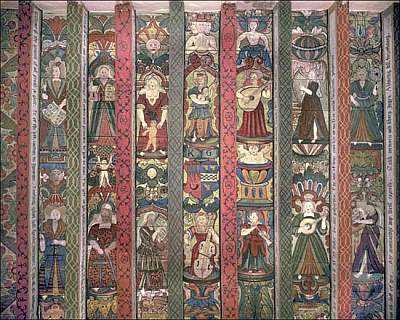
Above is a picture I found of the painted oak ceiling of the Chamber of the Muses. Apparently it was covered up for years and was rediscovered in 1877.

The views from the upper floor windows were stunning especially with the fall colors in the gardens and grounds.

A view out the windows of the roofs below and the gardens beyond.

The autumn colors in the gardens were spectacular.

The estate contains 530 acres and apparently the barn we’d gone to at first was the back part of the estate.

The estate also contains almost 4 acres of beautiful walled garden divided into 8 themed areas. I loved walking along the pathways among the flowers and shrubs. Being a gardener I saw many plants I recognized and would love to grow myself. The yew hedges date from around 1702.


The formal gardens were truly beautiful and amazing.


P.S.
I have a new interview posted at
The Romance Studio!
***
Sign up for my newsletter for a chance to win a perpetual Scotland calendar with beautiful photos!
***
Secrets Volume 29 Indulge Your Fantasies is now available on Kindle.


 (View from Skye Bridge)


 Spiral stone steps leading down. I love including these kinds of steps in my stories. It was neat actually being able to climb them. They are very narrow and tight. Basically it's almost impossible for two people to pass.


 This (above) is called the The Old Croft House with mill stones sitting outside. It is the largest building on this site. It contains three rooms, the most important of which is the kitchen where the fire was kept in the fireplace year round. The family gathered here to stay warm, to eat, etc. The fireplace used in the 1800s was an improvement and replaced the earlier central hearth which caused the whole house to be smoky. This house also contains a children’s bedroom with two box-beds, and a smaller parents’ bedroom. The Old Croft House was built at the beginning of the 1800s and was a real family home for about 150 years.


