Where Romance and History Meet - www.heartsthroughhistory.com/

Pages

Saturday, August 7, 2010

Abbreviated History of the Irish Travelers

Irish Travelers are descended from medieval minstrels and poets who traveled Ireland telling myths and stories. At that time, they were respected and learned. Travelers have their own language, Sheldroo, which is linked to ancient Irish language before a written Irish language. At the time of English occupation, many Irish families were turned out of their homes. During that period, it was illegal for Irish to learn to read and write—only the English could attend schools and universities. How were uneducated people to support themselves? Some homeless Irish families drifted in with the traveling minstrels and eventually became the Irish Travelers. They camped in fields. Later they acquired tents, then the colorful wagons that resemble gypsy wagons--as seen at the left in a photo from Bunratty Folk Park, Ireland.


They are not gypsies, though. Gypsies are Roms and originated in India. Travelers are purely of Irish origin, although they have now spread throughout the Western world. I saw examples of their wagons in a couple of museums in Ireland and in Scotland. Amazing how much storage space was inside the colorful wagons like those above. Lots of drawers and cabinets painted in cheerful colors and bunk resembling a sailing ship captain's quarters. Legislation in Ireland has set aside special camping places for the Travelers. There is much controversy there over whether the Travelers' children should be forced to attend school or allowed to remain uneducated and speak Sheldroo. In the U.S., they are supposed to attend school. There’s a large base of Irish Travelers in White Settlement, Texas and another in Los Angeles, California. In White Settlement, many live in RV’s or mobile homes at a park owned by one of the Travelers. The children don’t attend school, or if they go, it’s only sporadically. Most of the families are Roman Catholic and the wives attend mass. They were/are also called Tinkers because there was usually one among them who repaired pots, pans, and metal wares.


My first introduction to modern Irish Travelers—also called Tinkers—came one January day when a terrible accident happened on the Interstate just west of Fort Worth, Texas. A group of boys had been driving the new, red, double-cab pickup one received as a Christmas gift and going west to visit their uncle west of Weatherford. The five boys—all related—were going so fast when the driver lost control that the pickup actually became airborne, sailed across a median, and landed on another pickup traveling east. All six people died. Two were brothers, cousins to the other three brothers, plus the innocent man driving to Fort Worth. Highway patrol, sheriff’s deputies, and police officers were so moved by the deaths of these young men from one extended family that many of them attended the funeral in White Settlement. As they read the bulletin each person was given, they learned these young men were all underage. Their drivers licenses were fake. The ages were from 13 to 16, not 16 to 21 as the ID’s had indicated. Sadly, fake ideas are not uncommon for modern Irish Travelers. This accident sparked several in-depth columns about Irish Travelers in the Fort Worth Star-Telegram.


The photo above right is of a modern Irish Traveler selling various items at a roadside park in Scotland. The woman is the Traveler.  About three or four times a year, an Irish Traveler stops by our rural home and offers to pave our drive or repair our roof. The men are usually medium height and have startlingly clear blue eyes. If we were gullible enough—as one of our friends was—to let them resurface our driveway, they would use a mixture of fluid which might resemble asphalt, but actually would be oil which washed away in a hard rain. Another common ploy is to get a 50% deposit for roofing, then disappear.


I am not bashing Irish people! I’m of Scot-Irish descent and love anything to do with Ireland (and the UK). I’m identifying a stereotype. I’m sure there are some good people from the sub-ethnic group, Irish Travelers. As with many other subjects, we hear about the bad ones. For a couple hundred years, Irish Travelers have been thought of as con men and their wives as beggars. Some make good money. Others live hand to mouth. They’re accused of “selling” their daughters at a young age to marry much older men. Is that true? I don’t know. They’ve made national news because of their shoplifting rings. Are there honest Travelers? Of course there must be, just as there are honest and dishonest people from any group. I took the photo at left in Ireland. Sorry, but I can't remember where.


In my September book, THE TEXAN’S IRISH BRIDE, the heroine and her family were among those turned off their land by an English landlord. Rather than starve, they joined a band of Irish Travelers. How did they end up trekking across the U.S. into Central Texas? You’ll have to read the book to learn the answer. See, it was a trick question.


Thanks,


Wednesday, August 4, 2010

Texas Giant: Richard King of The King Ranch

Hello, Caroline Clemmons here filling in for Jeanmarie Hamilton, who has a home repair emergency today.

Because Jeanmarie and I each write Texas settings for our historical romances, I thught I'd include a post on Texas history. No groaning, please! I promise this will NOT be a pedantic treatise. Grades will not be taken nor test given. Probably. Okay, no tests. Let me tell you about Richard King, nicknamed The King of Texas.

In 1852, Steamboat captain Richard King embarked on one of the most profitable undertainkings of his life. He was a 27-year-old New Yorker riding the Texas prairie. He had fallen in love with the 17-year-old daughter of a Presbyterian minister and had begun contemplating other business ventures that might support a wife and family.  When King and a few companions reached Santa Gertrudis Creek about 45 miles southwest of Corpus Christi, King was impressed with what he saw.

He told his partner in the steamboat business that land and livestock had a way of increasing in value. Cattle, horses, sheep, and goats would reproduce themselves into value. Boats had a way of wrecking, decaying, falling apart, and decreasing in value and increasing in the cost of operation.

King met with his friend, Texas Ranger Gideon Lewis, and the two men hammered out a partnership to establish a small ranch on the banks of a creek in South Texas. King was to provide the capital while Lewis and his Ranger patrol would provide protection from rustlers and Indians. As his cattle operation grew, King located the Mexican owners of the original Spanish land grant to which he had staked his claim and purchased 15,500 acres from them for $300. Shortly afterwards he added 53,000 acres for which he paid $1,800. King was something of a visionary and dammed a small stream on the property. When drought hit the area--as it always does in any part of Texas--he was the only ranch with a good supply of water.

Over the next few years, the Santa Gertrudis ranch continued to grow, although King retained his share in the steamboat business.

 King and his foreman traveled across the Rio Grande to Mexico and bought cattle at low prices. On one occasion, after buying all the livestock in a particularly poor village, he offered to take the town's entire population back to the ranch and put them to work. This was the beginning of Los Kineros, the King People, progenitors of generations of intensely loyal Mexican tenant families who worked the King Ranch.

By the time the Civil War broke out, King was one of the largest landowners in Texas, if not the largest. With a wife and three children to care for, he had increased his holdings to support twenty thousand head of cattle and three thousand horses. He initiated a series of livestock breeding experiments that he hoped would result in better, more durable strains of horses and cattle.

After King's death in 1885, his son-in-law Robert Kleberg took over the operations of the ranch. Following in his mentor's steps, Kleberg and those family members who succeeded him turned the King Ranch into the world's largest livestock operation with branches in Pennsylvania, Kentucky, Cuba, Brazil, and Australia. King's initial efforts lived up to his name, The King Of Texas.

Reference, IT HAPPENED IN TEXAS, by James A Crutchfield, Falcon Press, Helena, Montana, 1996.

Thanks,


Monday, August 2, 2010

The Legend of the Kelpie


My latest story Beast in a Kilt was released last week in Secrets Volume 29 Indulge Your Fantasies. It is a paranormal historical erotic romance. The hero in this story is a special type of shapeshifter-- a kelpie.

Kelpies are a part of Scottish folklore and legend. Centuries ago, Scots believed certain lochs or rivers were inhabited by these malicious water demons. A kelpie appears to be a normal-looking, beautiful white (or black) horse. This creature charms and lures weary travelers onto his back and then dives into the loch or river, drowning and eating his victims. Kelpies have the strength and stamina of ten horses. And some legends say these kelpies could shift into gorgeous human males if they wanted. In this form they sometimes seduced women.

Of course Torr Blackburn, the hero of my story, doesn't drown people or eat them, but he does shift into a beautiful white "horse" at night and feels an intense, violent rage at times. When he's hungry, he eats grass or oats like a normal horse. He loves swimming in the nearby loch to burn off energy or aggression, and he never feels cold, even in midwinter. In kelpie form, he does, as legend says, have the strength of ten horses; he can run all night if required. (I used this picture of Gerry Butler as Attila as inspiration for Torr. Yes, he does like to smirk. ;-) )

Traditionally, the only way to capture a kelpie is with a magical bridle. If a person can manage to place this special bridle over his head, the kelpie is enslaved. And that's exactly what the witch of the dark arts does at one point--the witch who cursed him in the first place. The only way he can escape the curse is to find true love.

I thoroughly enjoy researching and creating paranormal stories, whether they are shapeshifter, time travel or magical. I can let my imagination fly free and ignore the restraints of everyday rationality and logic. Paranormal romance is pure escape and fantasy, yet still believable.

When I visited Scotland, I saw this sculpture called The Kelpies at the Falkirk Wheel.

I created this paranormal world in my first novella in this series, Devil in a Kilt, Red Sage Secrets Volume 27 Untamed Pleasures. The novellas take place in the year 1621 in Scotland. A dark witch placed a curse on three men who are friends and Highlanders (Gavin, Torr and Brodie) the year before because her son was killed in a skirmish in which he and his friends were trying to ambush and kill our three heroes. The witch took her revenge by placing a different curse on each of the three heroes. Gavin, the Highland chief from Devil in a Kilt, shapeshifts into a hawk. Only one thing will break the curse for each man, love given and received, in equal parts with complete trust. I've recently sold the third story in this series, Scoundrel in a Kilt for a future Secrets volume. The 3rd friend, Brodie, shapeshifts into a selkie. More on that Scottish legend later. :)

Here's the blurb for Beast in a Kilt:
Scottish lady Catriona MacCain has loved Torr Blackburn, a fierce Highland warrior, since she was a young lass, but Torr only sees Catriona as his best friend’s little sister. When Catriona’s family promises her in marriage to a detestable chieftain, she desperately needs Torr to save her from a fate worse than death. But Torr is under the spell of a witch of the dark arts and is cursed to spend his nights as a kelpie water demon. He doesn’t believe himself worthy of the virginal Lady Catriona. However, she is determined to seduce Torr and claim him… body, heart and soul, if only they can banish the curse and defeat the enemies who have vowed to possess and enslave them both.
What is your favorite legend, Scottish or otherwise?
Nicole

Saturday, July 24, 2010

Myths, Fables- all teach lessons


My August release, Spirit of the Mountain is available already in print format at my publisher. The Wild Rose Press. It's my first attempt at a paranormal, but to me it feels like a historical. I did major research into the Nez Perce or Nimiipuu tribe to be able to write this story about the daughter of a chief who is asked for in marriage by a warrior of the Blackfeet(Blackleg) tribe which at the time of the story were according to the words of a current Nimiipuu "considered the same as how you considered the Huns". I used this fear and hatred throughout the story when the heroine is talking and thinking about living with the Blackleg(the name the Nimiipuu called the Blackfeet).

I not only researched books on their day to day living conditions, their society, and their beliefs, I also read as much as I could in their own words. Myths and legends books and any snippet I could get that was in English but translated directly from their words. It helped me to get a feel for their speaking and cadence to their dialogue.

Here is a Nimiipuu story that I copied from the Nez Perce loop I'm on. As you can see by reading the story all of the stories handed down through the generations were like our fables. They taught a lesson.

Nez Perce boy legend

A long time ago there lived in our Blue Mountains a boy who was an only child. His parents had pampered and spoiled him until he was quite selfish and disagreeable.

His parents died and he was obliged to live with the rest of the tribe as an orphan. Because of his selfishness he was not well liked and the other children did not like to play with him. Some of the children learned that the camp was to be moved and made plans to get rid of the spoiled boy.

No one told him that they were moving and that morning they took him out to the high cattails to play hide-and-seek. They would hide and then call, "Who! Who!" Part of the time the boy was following his own echo. The children slipped away and hurried back to the camp in time to go.

The boy wandered about listening to his own echo for some time before he decided that the others had left. When he found his way back to camp it was deserted.

He was hungry and by rummaging about he found some roots that had been left. Still hungry, he decided to try some fishing. With a thorn on an improvised string he made from fibers and hair left at the camp, he placed a worm on the thorn and fished. Thus he secured fish.

Not wishing to eat it raw, his mind turned to fire, and investigation proved that someone had banked a bed of coals and he soon had a camp fire going.

Night was approaching. Where would he sleep? At last he remembered the little stone and mud igloo down by the stream where the people had taken their sweat baths. He crawled into the igloo and slept quite comfortably.

In the morning, he decided to try fishing, but this time a strange thing happened. When he felt something on his line he pulled steady and hard. Slowly it came, but it was not a fish. It was a boat loaded with many provisions and an extremely homely old lady. The old lady spoke to him, "Don't be afraid little boy, I will not hurt you. I am your Grandmother Experience. I have come to help you."

Grandmother Experience lived with him, after that and helped him do many things - make bows and arrows to kill game, gather food, build shelters, and many other things.

Time went on and the boy lived with the grandmother and grew up big and strong, but wondered where his people were. He commenced traveling about in hopes of finding them. One day he did find them and they marveled at the change he had undergone. He was no longer a spoiled selfish boy. Grandmother Experience had made a self-reliant, pleasant young man of him.

If you'd like to read an excerpt of my book Spirit of the Mountain you can visit my website: www.patyjager.net and click on paranormal. While you're there enter my website contest.
I'll be blogging for six days straight at Seriously Reviewed starting tomorrow, Sunday July 25th. Come on by and read about my hero and heroines from my last two releases. The last day I’m giving away a pdf of Doctor in Petticoats my historical western that released in June. And starting on Sunday August 8th I'm doing a six day blog tour with a contest. Check out my blog to learn more.

Thursday, July 22, 2010

Sex in the City

Despite modern-day beliefs, working women in medieval times were not just relegated to going into unpaid domestic service or running a household. Many skilled tasks were carried out in craftsman’s house or workshop. Wives and daughters were often called upon to assist in the tasks at hand. Though the regulations of many guilds expressly forbade entrance by women, exceptions were made for female family members of a guild member. By the late middle ages there were many cases of widows continuing to run the business after their spouse’s death. Many times men expected their wives to carry on even to the point of providing in their wills that any apprentices must serve out their term under the tutelage of the widow.


Trades carried on by such widows ranged from small crafts to large merchants trading in all kinds of goods. To manage such large businesses, these women had to be knowledgeable and hearty. One such was Alice de Hortsford whose ship was confiscated as the property of someone else by the marshal. Alice stood before the crown justice and proved title to the ship. The court ordered the vessel and goods returned. After the death of her wealthy merchant husband, Rose of Burford petitioned the royal court at least five times to recover a loan made to the King. When it became apparent that the crown was either unwilling or unable to repay the debt, Rose came up with the suggestion that the loan might be settled by removing the tax levy on the import of her goods. The crown felt that was more than reasonable and Rose brought her goods in tax free for several years.


However, widows were not the only female business owners. Married women many times had occupations distinct from those of their husbands. Many unmarried women supported themselves as shopkeepers. Especially in major cities, girls were often apprenticed to a trade just like boys. Whereas a nobleman might leave a dower in his will so his daughter might be married or put in a nunnery, an urban craftsman or merchant would leave a sum so that his daughter might be married or apprenticed to a trade. Women so apprenticed could ply the learned trade so long as they remained unmarried, as femme soles. Even though most guilds had rules regarding women other than wives and daughters, there is hardly a trade that women did not ply. There are records of women ironmongers, butchers, net-makers, chandlers, glovers, cobblers, haberdashers, purse-makers, bookbinders, spinners, smiths and many others.


Though their wages were sub-standard and many times men were loath to admit it, women were an important part of the labor market in medieval times.

Wednesday, July 21, 2010

Bad Boys - And TheWomen Who Tame Them

Last month, I posted a tribute to bad boys. Judging from the comments, I was right - romance readers and writers love our bad boys. Bad boy characters are appealing on a variety of levels. They’re highly sexual, they thrive on challenges, including women who challenge them, they don’t run from a fight, and in a great romance, they harbor a protectiveness for the heroine that brings out the best in the man.

But what about the woman who inspires a bad boy to be a man? What makes a heroine who tames a bad boy, and does it in a way that doesn’t make me go, “Yeah, right, that would happen…what was the author thinking?”

A bad boy’s heroine is just as sexual a creature as he is. Often, though, she doesn’t know it yet. Grease’s heroine, Sandy, certainly wasn’t attracted to Danny Zuko for his brains. She may have been innocent, but there was an inner Rizzo, waiting to get out – in fact, Sandy might have been more sexual than Rizzo, the outwardly worldly character. She certainly seemed to know what she wanted with more clarity than the bedhopping leader of the Pink Ladies. In my novel, Destiny, Emma is a romance-loving innocent, longing to be swept away by a brooding lover like Heathcliff or Mr. Rochester. Her abduction changes all that. Her captor, Jack Travis, soon teaches her that an alpha-male with a heart is hard to resist, and that surrender to her heart can be very satisfying.

A bad boy’s heroine might have buried her desire, but it’s still there, presenting a challenge to the hero to bring it to the surface. In Claiming the Courtesan, the heroine, Verity, is noted as the most desirable courtesan in her circles, but she’s actually turned off her own responses. For Verity, sex is a skill, not a pleasure. Until Kylemore unleashes the power of love and with it, the pleasure of her sexual interactions with the hero.

Bad boys love challenges. Physical challenges. And intellectual challenges. Even Danny Zuko, who certainly wasn’t known for his brains, fell for the smart girl. At their ideal, the bad boy is as proficient mentally as he is physically. In Sherlock Holmes, Robert Downey, Jr. essays a character who’s athletic and brilliant, so it comes as no surprise that the love of his life, Irene Adler, is as brilliant as he is. The fact that she’s chosen to put her brains to use as a thief rather than a crime-solver seems a natural pairing of opposites. A bad boy wants a girl who will match wits with him and spar with him, not simply nod in meek agreement.

To be believable, a bad boy’s heroine has to be strong, gutsy, and ultimately devoted to the hero. In Destiny, Emma Davenport, a powerful senator’s daughter, has lived a sheltered life, but that doesn’t stop her from running away to a forbidden marriage, matching wits with the arrogant captor who snatches her from a train, and ultimately, saving his life. Emma’s strong will, keen intelligence, ingenuity, and guts are irresistible to the alpha hero. Like Emma, Marion in Raiders of the Lost Ark is courageous, strong willed enough to challenge the swashbuckling Indiana Jones, and smart enough to challenge his intellect when he’s morphed back into Dr. Henry Jones, the professor. She doesn’t rely on her beauty or flaunting her sexuality, but there’s no doubt of the chemistry between the hero and heroine.

Romance is filled with feisty heroines and the bad boys who love them. One of my favorite new heroines is Catherine Marks, Leo’s love in Lisa Kleypas’ wonderful Married by Morning. Her sharp wit intrigues bad boy Leo long before he realizes she’s actually a beauty who’s taken great pains to drab down her looks. Catriona Kincaid in Teresa Medeiros’ Some Like It Wicked is a perfect heroine for dissolute former war hero Simon as she challenges him and inspires him to be the man he’s meant to be.

Who are some of your favorite women who tame bad boys from romance and film? What do you love most about them? I’ll choose a random commenter to win a pdf of Destiny.

Monday, July 19, 2010

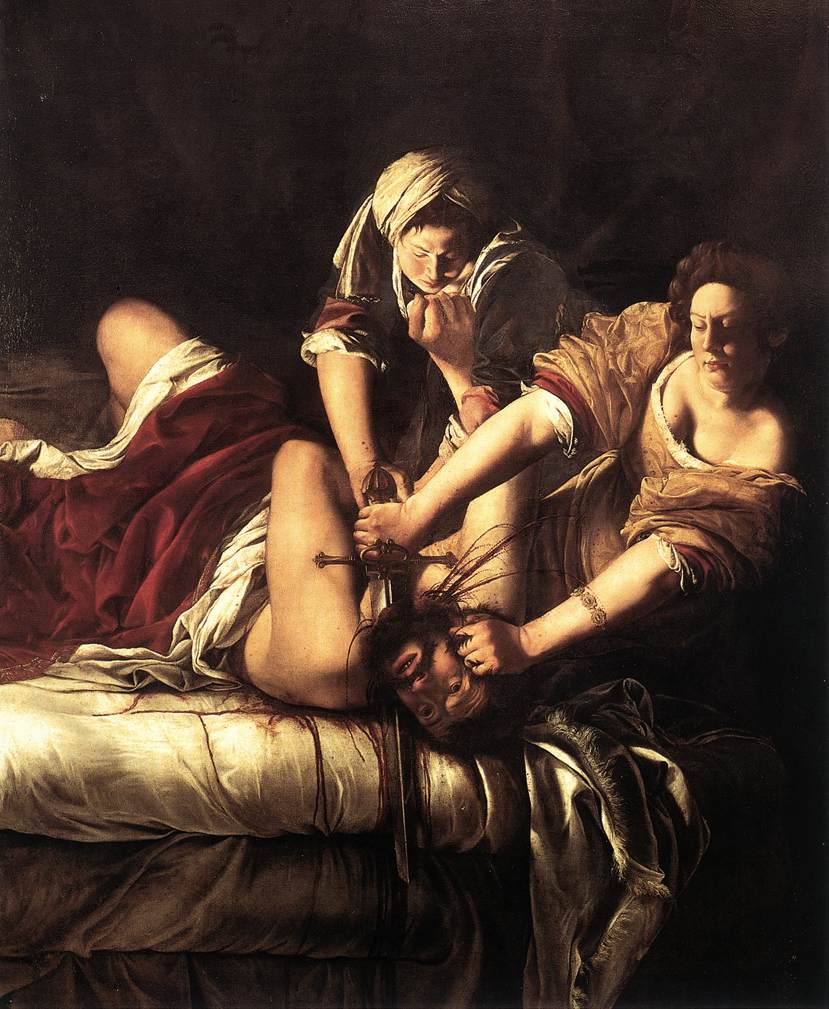
Artemisia Gentileschi

I’ve discovered another great book – LADIES FIRST: History’s greatest female trailblazers, winners and mavericks by Lynn Santa Lucia. “LADIES FIRST is a fascinating account of some of history’s most inspiring women….Adventurers and athletes, politicians and scientists, artists and educations, revolutionaries and criminals—LADIES FIRST celebrates some extraordinary women who have singularly and collectively cleared a path for other females to follow,” so says the inside flap of the book. The book offers biographies and insight on more than three dozen women, from Pharaoh Hatshepsut (ruler of ancient Egypt) to Razia Sultan (warrior queen of India) to Hildegard of Bingen (Renaissance woman) to Marie Curie (two-time Nobel Prize laureate) to Sally Ride (America’s first female astronaut) to a whole bunch of other fascinating women

Today’s post is about Artemisia Gentileschi: Italian early Baroque painter, who defied convention and torture, lived from 1593 to 1653. (111)  (Self portrait at right)

Artemisia Gentileschi was born to the Italian painter Orazio Gentileschi who took her under his wing after her mother died when Artemisia was twelve. She shied away from landscapes and portraits as the female painters of her time often painted. Instead, Artemisia crafted religious and historical paintings.

By the age of seventeen, she had already accomplished her best known work SUZANNA AND THE ELDERS (1610). Still she was denied her ‘professional academes’ because of her sex.

In an effort to enhance her training, her father hired his friend, Agostino Tassi to help train Artemisia. Tassi, however, proved to be a lecher and lout when he tried to seduce her. When his efforts failed, he resorted to raping his young student. After she reported the rape, Tassi offered marriage (!), however, he remained a lout when he reneged on the promise. Orazito sued on behalf of his daughter for breach of contract.

Tassi was eventually found guilty of the rape and sentenced to serve a one-year jail term. However, during the seven month trial, “Artemisia was tortured to make sure that she wasn’t fabricating her allegations.” (113)

As if a cathartic and symbolic attempt to deal with the physical and psychic pain, she painted JUDITH SLAYING HOLOFERNES (1612), not with the usual horrified Judith, but with a Judith of grim determination. It was a scene she painted many times in her life. (I want to know if Holofernes bares any resemblance at all to Tassi or one of her torturers).

Just a month after the trial ended, Orazio married Artemisia off to another artist in an effort to restore his daughter’s honor. The couple had several children, but only one, a daughter, survived to adulthood. Artemisia eventually left her husband.

She moved about Italy the next few years, living in Rome, Genoa and Venice. In 1630, she settled in Naples, where “her patrons included all the crowed heads of Europe at the time.” (113)

In 1638, King Charles I requested she come to England and Artemisia traveled to London, meeting up with her father, who was already painting for the king. Orazio died before finishing his work on the ceiling of Queen’s House in Greenwich, London and it is speculated that Artemisia finished the job in honor of her father. (115)

She returned to Naples in 1642 and remained there until her death in 1653.

Ignoble of the art world, her works were often attributed not to her, but her father. Recent interest in her works are rectifying this matter. It should not be overlooked that Artemisia Gentileschi was the first female to become a member of the Accademia dell’Arte del Disegno in Florence.

Learn more about Artemisia at:

Artemisia Gentileschi - The University of Arizona

Okay, leave a comment before July 23rd and I'll draw a winner for LADIES FIRST, a book I've found to be a wonderful research tool.  (I may not announce the winner until after I return from the RWA National Conference)
~~~~~~~~~~~~~~~~~~~~~~~~~~~~~~~~

Anna Kathryn Lanier
Where Tumbleweeds Hang Their Hats
http://www.aklanier.com/
http://annakathrynlanier.blogspot.com/