Where Romance and History Meet - www.heartsthroughhistory.com/

Pages

Showing posts with label The Wild Rose Press. Show all posts

Thursday, October 6, 2011

INDULGING OUR FANTASIES

19th Century cabin
One of the greatest things about writing is that authors are able to indulge their own fantasies. One of mine is that I would have loved living in the West during the last part of the 1800’s. Maybe! At least until the weather was severe and I had no central heat/air, no clean bathroom with running water, no antibiotics, and on and on. It’s a romantic time to consider, which is why I love writing romances set in the American West (probably much more than I would like returning to that time).

Maureen O'Hara
Another of my fantasies is that I wanted to look like the young Maureen O’Hara. More’s the pity, for I look nothing like her. But we’re talking about fantasies, right? This is why Cenora Rose O’Neill, the heroine of my 2010 western romance, THE TEXAN’S IRISH BRIDE, strongly resembles Miss O’Hara in appearance. What authors can’t accomplish ourselves, we accomplish through our characters.


When the infamous 1845 Irish potato famine struck and millions in Ireland literally starved to death, there was a mass immigration of Irish into the United States. But the O’Neill family didn’t lose their land in the famine. They were turned off many years later by a spiteful landlord. Due to her lack of schooling, Cenora cannot read cursive and reads only a few words in print. Her father, Sean O’Neill, can read a newspaper (slowly), and has done all the reading for his family and their traveling companions. On the other hand, the McClintocks value education, and Dallas McClintock reads most evenings. This difference causes only one of the many conflicts that arise in the book.


Irish cottage
When forced off their plot of Irish land with only what they could carry, Cenora and her family fell in with a group of Irish Travelers. The Travelers, or tinkers, are not gypsies but are descended from medieval minstrels and poets who traveled Ireland telling myths and stories. In medieval times, the minstrels and poets were respected and learned. Many Irish families turned out of their homes drifted in with the traveling minstrels, eventually becoming the Irish Travelers--not so respected or learned. Travelers have their own language (cant), Sheldroo, which--amazingly enough--is linked by scholars to medieval language. They camped in fields at first. Later they acquired tents, then the colorful wagons that resemble gypsy wagons, such as the ones used in my novel. Like people everywhere, some Irish Travelers are good, some are bad. The same is true for those portrayed in THE TEXAN’S IRISH BRIDE.


Irish fields
The 19th and early 20th century Traveler wagons are unbelievably compact, and are brightly painted inside and out in red, blue and green with yellow pinstripes. Seeing them in several museums brought home the skill and functionality of these wagons. That describes the two wagons acquired by the O’Neills through their ability to play instruments while Cenora sings for crowds when they pass through towns. Unfortunately, Sean O’Neill’s only abilities are playing music and the gift of gab--not much to supply a family’s needs. His sons Finn and Mac trade ponies for a bit of extra coin and the family barely gets by. On the other hand, rancher Dallas McClintock has a strong work ethic and sense of honor. You can see more trouble looming, can’t you?
 In THE TEXAN’S IRISH BRIDE, Cenora Rose O’Neill knows her father somehow arranged the trap for Dallas McClintock, but she agrees to wed the handsome stranger. She’d do anything to protect her family, and she wants to save herself from the bully Tom Williams. She believes a fine settled man like Dallas will rid himself of her soon enough, but at least she and her family will be safely away from Williams.


Texas rancher Dallas McClintock has no plans to wed for several years. Right now, he’s trying to establish himself as a successful horse breeder. Severely wounded rescuing Cenora from kidnappers, Dallas is taken to her family’s wagon to be tended. He is trapped into marrying Cenora, but he is not a man who ever goes back on his word. His wife has a silly superstition for everything, but passion-filled nights with her make up for everything—even when her wild, eccentric family nearly drives him crazy.


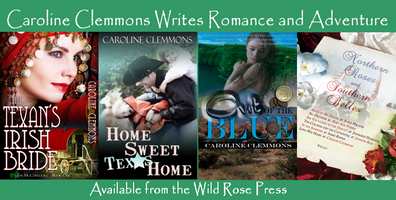
I hope you’ll read and enjoy THE TEXAN’S IRISH BRIDE. The gorgeous cover is one of my favorites. The buy link for THE TEXAN’S IRISH BRIDE is www.thewildrosepress.com/caroline-clemmons-m-638.html in print and e-download, and it’s also available at Amazon and other online stores. My website is http://www.carolineclemmons.com/. Other books at The Wild Rose Press are the contemporary romance HOME, SWEET TEXAS HOME, historical SAVE YOUR HEART FOR ME, and paranormal time travel OUT OF THE BLUE. My backlist is now available on Smashwords and Amazon Kindle for 99 cents each, and so is my new mystery, ALMOST HOME.

Friday, January 21, 2011

The Allure of Edgar Allan Poe

 Many of my recent posts have dealt with the Civil War era - in particular, spies during the War between the States. I'm fascinated with that era - that interest has led me to write two historical romances set during the Civil War, with a third on its way. However, this post has nothing to do with the Civil War or spies or daring alpha males. In honor of the 212th anniversary of the birth of Edgar Allan Poe on January 19, I took another look at the life and legacy of Poe and the mysterious Poe toaster.

Three roses and a half-bottle of cognac – a fitting toast to the man who created a literary genre, contributed to the development of short stories as a literary form in American literature, and created macabre images that have spawned countless nightmares, influenced literature and served as the inspiration for . For sixty years, an unknown visitor (or perhaps, visitors), clothing positioned to obscure his identity, ventured out to Poe’s grave during the wee hours of the night to drink a toast and leave the flowers and liquor at his grave. Visitors from across the country journeyed to Baltimore to witness what had been an annual event from 1949 until January 19, 2010, when the  Poe Toaster failed to show. The Poe Toaster’s absence again this year leads one to wonder if the Toaster has passed away, taking the mystery of his identity with him forever.

How fitting that the so-called Poe Toaster (and his conspicuous absence) should be shrouded in mystery.  Edgar Allan Poe was known for his literary mysteries and created the detective fiction genre decades before Sir Arthur Conan Doyle created Sherlock Holmes.  His life clouded by tragedy and cut short at the age of forty under mysterious circumstances from a cause that has never been determined, I imagine the man whose stories of horror and mystery changed American literature would have richly enjoyed the aura of mystery surrounding a simple bottle of cognac and a few cut flowers laid on his grave.

I’ve always been fascinated by Poe’s works such as The Murders in the Rue Morgue and intrigued by the concept that a modern day pro-football team is named after a poetic work by a man who died long before football became a national obsession. Certainly it’s no coincidence Baltimore’s professional football team is dubbed the Ravens. Poe’s works have inspired hundreds of movie and television works (he even has a page on the Internet Movie Database – not bad for a man who died in 1849), and I have to admit to enjoying corny Vincent Price movies loosely based on Poe’s works – in some cases, it seems only the title was used.  Poe’s death was as mysterious as his works, and he’d certainly experienced tragedy and heartbreak. I won’t bombard you with details on Poe’s life. Suffice it to say his life might have provided fodder for a melodrama. Orphaned as a young boy when his actress mother died and his actor father abandoned his family, he was taken in by a family that raised him but never adopted him. Eventually disowned by his foster family, Poe foundered at college and in the Army, lost a brother to alcoholism, and buried his young wife after two years when she succumbed to tuberculosis. By the time of his death, he was believed to be drinking heavily and exhibiting erratic behavior. Despite these woes, Poe harnessed his literary genius to create an enduring legacy.

He wasn’t a conventionally handsome man, but there was definitely a dark, penetrating quality to his eyes. Poe wasn’t tall (Army records list his height as 5’8” ), and he was definitely not the man to bet on in a bar fight. But his moody genius would have made him quite intriguing. And possibly quite passionate.

So, here’s my question – would a man like Poe have made the cut as a romantic hero? While the vast majority of romance heroes are undisputed alpha males, the beta male offers an undeniably unique appeal. Edgar Allan Poe could be considered a beta male. Intelligent, prone to star-crossed romance, the type of man to use a pen rather than a sword – just the kind of man a strong woman could engage in a battle of wits and claim lasting love as his victory…intriguing possibilities, indeed. It’s fascinating to imagine what might have happened if Edgar Allan Poe had met a woman who was his intellectual equal. And equally fascinating to consider the plot possibilities of a hero with Poe’s moody romanticism. Do I feel a story forming?

Saturday, August 7, 2010

Abbreviated History of the Irish Travelers

Irish Travelers are descended from medieval minstrels and poets who traveled Ireland telling myths and stories. At that time, they were respected and learned. Travelers have their own language, Sheldroo, which is linked to ancient Irish language before a written Irish language. At the time of English occupation, many Irish families were turned out of their homes. During that period, it was illegal for Irish to learn to read and write—only the English could attend schools and universities. How were uneducated people to support themselves? Some homeless Irish families drifted in with the traveling minstrels and eventually became the Irish Travelers. They camped in fields. Later they acquired tents, then the colorful wagons that resemble gypsy wagons--as seen at the left in a photo from Bunratty Folk Park, Ireland.


They are not gypsies, though. Gypsies are Roms and originated in India. Travelers are purely of Irish origin, although they have now spread throughout the Western world. I saw examples of their wagons in a couple of museums in Ireland and in Scotland. Amazing how much storage space was inside the colorful wagons like those above. Lots of drawers and cabinets painted in cheerful colors and bunk resembling a sailing ship captain's quarters. Legislation in Ireland has set aside special camping places for the Travelers. There is much controversy there over whether the Travelers' children should be forced to attend school or allowed to remain uneducated and speak Sheldroo. In the U.S., they are supposed to attend school. There’s a large base of Irish Travelers in White Settlement, Texas and another in Los Angeles, California. In White Settlement, many live in RV’s or mobile homes at a park owned by one of the Travelers. The children don’t attend school, or if they go, it’s only sporadically. Most of the families are Roman Catholic and the wives attend mass. They were/are also called Tinkers because there was usually one among them who repaired pots, pans, and metal wares.


My first introduction to modern Irish Travelers—also called Tinkers—came one January day when a terrible accident happened on the Interstate just west of Fort Worth, Texas. A group of boys had been driving the new, red, double-cab pickup one received as a Christmas gift and going west to visit their uncle west of Weatherford. The five boys—all related—were going so fast when the driver lost control that the pickup actually became airborne, sailed across a median, and landed on another pickup traveling east. All six people died. Two were brothers, cousins to the other three brothers, plus the innocent man driving to Fort Worth. Highway patrol, sheriff’s deputies, and police officers were so moved by the deaths of these young men from one extended family that many of them attended the funeral in White Settlement. As they read the bulletin each person was given, they learned these young men were all underage. Their drivers licenses were fake. The ages were from 13 to 16, not 16 to 21 as the ID’s had indicated. Sadly, fake ideas are not uncommon for modern Irish Travelers. This accident sparked several in-depth columns about Irish Travelers in the Fort Worth Star-Telegram.


The photo above right is of a modern Irish Traveler selling various items at a roadside park in Scotland. The woman is the Traveler.  About three or four times a year, an Irish Traveler stops by our rural home and offers to pave our drive or repair our roof. The men are usually medium height and have startlingly clear blue eyes. If we were gullible enough—as one of our friends was—to let them resurface our driveway, they would use a mixture of fluid which might resemble asphalt, but actually would be oil which washed away in a hard rain. Another common ploy is to get a 50% deposit for roofing, then disappear.


I am not bashing Irish people! I’m of Scot-Irish descent and love anything to do with Ireland (and the UK). I’m identifying a stereotype. I’m sure there are some good people from the sub-ethnic group, Irish Travelers. As with many other subjects, we hear about the bad ones. For a couple hundred years, Irish Travelers have been thought of as con men and their wives as beggars. Some make good money. Others live hand to mouth. They’re accused of “selling” their daughters at a young age to marry much older men. Is that true? I don’t know. They’ve made national news because of their shoplifting rings. Are there honest Travelers? Of course there must be, just as there are honest and dishonest people from any group. I took the photo at left in Ireland. Sorry, but I can't remember where.


In my September book, THE TEXAN’S IRISH BRIDE, the heroine and her family were among those turned off their land by an English landlord. Rather than starve, they joined a band of Irish Travelers. How did they end up trekking across the U.S. into Central Texas? You’ll have to read the book to learn the answer. See, it was a trick question.


Thanks,