Where Romance and History Meet - www.heartsthroughhistory.com/

Pages

Friday, June 18, 2010

Working Women of the West

by Anna Kathryn Lanier

Women of the West during the 1800’s had greater freedom and more opportunities as proprietors than their counter-parts in the East. Labor shortages and the more lenient attitude toward women’s roles opened doors for women in commerce unavailable in the more Victorian-minded East.

Common businesses were laundries, baking, house cleaning, boarding houses, hotels, restaurants, seamstress, even post mistress. The men may have come West for freedom, but they still wanted clean clothes, fresh pies and a place to sleep.

Luzena Wilson, without her husband’s knowledge, built a table herself and set up an outdoor restaurant. When her husband returned that evening he found twenty miners sitting at her table, paying a dollar each for the food she cooked. Her business was so successful, she was able to build a hotel and lend money to others.

Mary Jane Caples decided to sell pies to the miners in the area. Using dried fruit, she sold the pies “for one dollar and a quarter a piece, and mince pies for one dollar and fifty cents. I sometimes made and sold a hundred in a day, and not even a stove to bake them in, but had two small dutch ovens.”

Another woman boasted, “I have made about $18,000 worth of pies—about one third of this has been clear profit. One year I dragged my own wood off the mountain and chopped it, and I have never had so much as a child to take a step for me in this country. $11,000 I baked in one little iron skillet, a considerable portion by a campfire, without the shelter of a tree from the broiling sun.”

Several women owned boarding houses, one made $189 a week within three weeks of opening her place.

But these occupations weren’t the only way for a woman to make her way in the west. The Historic Hwy 49 site offers a list of woman and their successful enterprises:

Catherine Sinclair managed a theatre. A French woman barbered. Julia Shannon took photographs. Sophia Eastman was a nurse. Mrs. Pelton taught school. Mrs. Phelps sold milk. Mary Ann Dunleavy operated a 10-pin bowling alley. Enos Christman witnessed the performance of a lady bullfighter. Franklin Buck met a Spanish (“genuine Castillian”) woman mulepacker. Charlotte Parkhurst drove a stage for Wells Fargo. Mrs. Raye acted in the theatre. Mrs. Rowe performed in a circus, riding a trick pony named Adonis. Lola Montez and Lotta Crabtree were famous dancers. Lotta amassed a fortune of over four million dollars during her lifetime.

Other women took up more historically masculine jobs such as gold mining and muleskinners (someone who drove cargo using mules). And physician, hundreds of women practiced medicine in the West, where they were more accepted, too.

The possibilities for a woman were nearly as limitless as the wide open spaces of the Old West.

What occupation are you inclined to give your heroine if your story were set in the 1800’s American west? Leave a comment and you could win a copy of “Texas Chuckwagon Cuisine: Real Cowboy Cooking.”

Sites to visit:
http://www.historichwy49.com/women/women.html
http://www.goldrush.com/~joann/women.htm

Anna Kathryn Lanier
Where Tumbleweeds Hang Their Hats
http://www.aklanier.com/
http://annakathrynlanier.blogspot.com/

Sunday, June 13, 2010


I love Cowboys

As if you didn’t know from reading any of my blogs, I love the American West. The West, along with the American Revolution are part of the defining characteristics of the United States.

While I’m still writing historicals set in the West, I also trying my hand at a contemporary story, set of course in the west, and the hero is a rodeo cowboy.

The modern day rodeo, with it prize money, electronic timers, and PRCA (Professional Rodeo Cowboys Association) had its roots in the everyday work and life of the historic cowboy.

The word rodeo (row – di – o) comes from the Spanish word rodeo (row-day-o) with just a different accent on the syllables, derived from the Spanish verb ‘to surround’ or round up. Naturally the cowboy who was the best at his job had the respect of the other cowboys. And, being competitive, the idea of having a competition to see who was the best at a certain skill was a foregone conclusion. Thus, the rodeo.

Original rodeos were unofficial and often held at the end of a spring or fall roundup. The skills need for the round up were the skills tested in the rodeo. Such skills riding a ‘green broke’ horse that were often used to start a round up cutting a cow out of the herd, or roping cattle for branding.

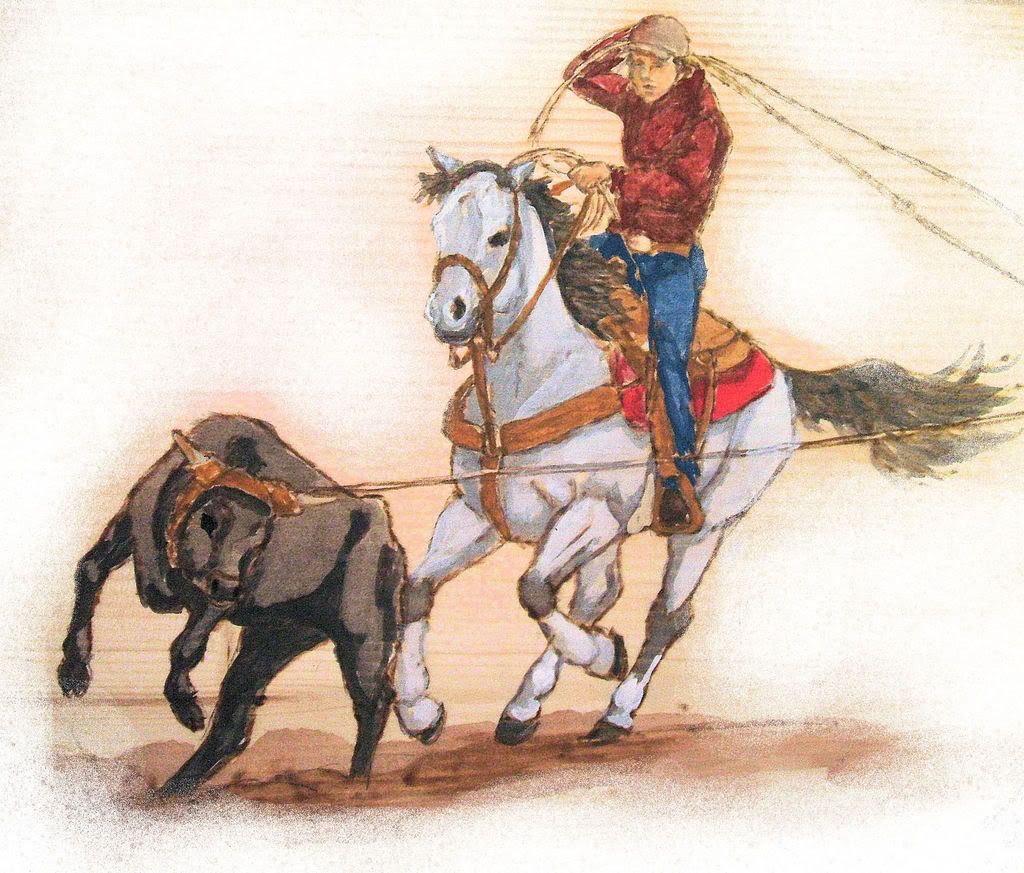
Today the events are bronc riding, both with a saddle and bareback, calf roping, and team roping (where one cowboy ropes the head and the other cowboy the heels of the cow).

Did you know that the actor Ben Johnson, who appeared in many western movies from the 40s to the 70s had been the Steer Roping Champion in 1953?

As the rodeo became more organized and profession events were added that were not actually part of the working cowboys repertoire.


Really, how many cowboy actually jumped off a horse to grab a steer by the horns and wrestle him to the ground (what did they think that rope was for?). Bulldogging, or steer wrestling was ‘invented’ by Bill Pickett, a black cowboy.


Another invented event is bull riding. I can’t help but think one cowboy said to another, ‘yeah, you can ride a bronc, but could you ride a bull?’

One of my bucket list items it to attend the Calgary Stampede or the Cheyenne Frontier Days. Yes, there is nothing like a long, lean man in levis, boots and a cowboy hat. (Sigh)

How about you, are cowboy one of your favorites?

Saturday, June 12, 2010

Old Town ~ Where San Diego really began!


The book I'm currently working on takes place in 1888. Although much of it takes place in New San Diego, there are still parts that take place in Old Town.

Here, the San Diego River coursed by on its way to empty into the harbor where tall sails from sailing ships pierced the sky. Here, one main plaza and street bisected the small town of low red-tiled roofs and adobe buildings. A few stunted trees fought to survive in the dusty yards. A newspaper office, cantina, school house, Wells Fargo & Company, a Catholic church—built with wood transported down from the mountains or brought by boat from northern California.


It always helps me to visit the place that I'm writing about--catching the scent of the ocean breeze and the sagebrush, the warmth of the February sun against the cool shade, and the cry of the gulls--helps to infuse my writing with authenticity.


Old Town is one of my favorite places to go in San Diego. The scent of spicy Mexican food hovers in the air at meal-times which makes it nearly impossible not to purchase a churro or burritos. I can just hear the stomp of a bored burro as it waits for its owner tied outside the Colorado House, or hear a busy mother taking a moment to yell down the street after her children "Cuidado!" (Be Careful!)

It's difficult to imagine such an inauspicious beginning to a city that now sparkles like a jewel with its skyscrapers, pristine beaches, and miles of highway.

Do you live near a historic district? One that sparks your imagination of what it must have been like hundreds of years ago? If you could, would you want to time travel back to that time?


Tuesday, June 8, 2010

What's In A Name?

"What’s in a name? That which we call a rose/By any other word would smell as sweet."


Well, Will Shakespeare certainly had a valid point when he wrote Romeo and Juliet, but I’ve discovered that my writing has a few instances where names caused me a few problems.

Take my first novel, In Sunshine or in Shadow. The hero, Rory O’Brien, comes to the village of Ballycashel under an assumed name, David Burke. His true identity is eventually unveiled, of course, but before that happens, I had to be very careful what I wrote.

Rory had to be “David Burke” to the people of the village. But when I was in his POV (Point of View, for any non-writers), I had to have him think of himself as Rory. And when I was in another character’s POV, a character who didn’t know he was really Rory O’Brien, I had to have them refer to him as “Mr. Burke,” while he thought of himself as Rory.

There were times when it got really confusing.

So what happens? I create another character in another work in progress. This time it's Lucas Howard. Or is it Lucas Davenport? Or perhaps he's Luke Davenport.

Lucas Davenport is the younger son of a Philadelphia businessman. Estranged from his family, he left Philadelphia to become an actor and took the stage name of Lucas Howard. His father and sister call him Luke, his mother calls him Lucas.

In Coming Home, my upcoming release from Highland Press, none of the characters have nicknames, or aliases. My heroine is just plain Ashleen O'Brien, my hero Cavan Callaghan. They may have a few secrets from one another, but thankfully, those secrets have nothing to do with their names!

Monday, June 7, 2010

Palo Pinto Mountains, Hell's Gate, and Possum Kingdom Lake

Yes, these are real places. In my current time travel romance from The Wild Rose Press, OUT OF THE BLUE, the hero’s mom, Blossom Hunter, has a lovely lakeside home at Possum Kingdom Lake. Folks in our area call it simply “PK.” The hero, Brendan Hunter, is on medical leave from his job as police detective in the fictional city of Radford Springs when the heroine, Deirdre Dougherty, plops down into Possum Kingdom Lake beside his bass boat. She's from 1845 Ireland and thinks she landed at the literal gates of Hell. But that’s another story.

Let me tell you about the Palo Pinto Mountains, Possum Kingdom Lake, and Hell’s Gate. It tickles me that the fictional name in my book is the one that sounds logical, Radford Springs, the town where Brendan Hunter is a police detective and where Blossom Hunter owns a health food store. In truth, there is no large town near PK. Graham and Mineral Wells are the closest towns of any size, and they're both small towns.


One of my favorite drives is from Highway 180 just outside the county seat of Palo Pinto County south on Highway 4 to Interstate 20. This is a winding road through hills reminiscent of New Mexico’s mountains. They may look like hills overall, but the Palo Pinto Mountains are geologically a genuine mountain range. The scrub oaks which cover the hillsides turn bright oranges, golds, and yellows in fall, which gives them the Palo Pinto name that roughly translates as painted posts. Anglo settlement began in 1842 with the establishment of Peter’s Colony. Oliver Loving and Charles Goodnight were early ranchers in the area and Loving is buried in nearby Weatherford. Anyone who wants to know more about early ranching in the area should read PAINTED POLE, The Beldings and Their Ranches in Palo Pinto County: Pioneer Days to Computer Age, by Barbara Belding Gibson, from Sunbelt Eakin Press, ISBN 1-57168-561-8. The Belding Ranch has been continuously owned by a member of the family since 1859 and the book gives a good early look at North Central Texas ranching in the 19th century as well as today. In fact, Barbara and her husband Charles Gibson live in the original home. Rather, the original cedar log cabin has been built onto and around and is now a bathroom for their home. Hard to imagine living in a home eight feet by eight feet, isn’t it? They’ve also incorporated the smokehouse and cool room into their home. I love when people respect the past and preserve rather than destroy it.

Many places in the country have a formation known as Hell’s Gate, but here’s the story of how this one supposedly received its name. In the 1800’s, two fur trappers were making their way down the headwaters of the Brazos River. Their pack animals were loaded with trinkets and rotgut whiskey to use as barter in case they met up with any friendly Indians willing to trade. They came upon an encampment of friendly Comanche who had furs and were willing to trade. After several days of barter, the trappers noticed that the best furs were still in the Indians’ pile. The traders were not of the highest moral character and decided it was time to bring out complimentary samples of their rotgut whiskey. Later that night after all the braves had passed out and were asleep, the trappers loaded up the Indians’ furs on their pack burros and headed south down the Brazos. Not only do you have to be greedy to cheat Comanches, you have to be extremely stupid!

To illustrate that crime doesn’t pay, these greedy traders ran into bad luck. One burro broke his leg, so a second had to carry double and soon gave out. The last burro so heavily loaded lost its footing and fell into the canyon below and died. The trappers weren’t making very good time. They realized by now the Comanches they’d stolen from would be sober and awake and on their trail. Smoke signals could be seen and the traders knew their victims were closing in for the kill. They’d reached a point on the Brazos with high limestone cliffs divided by a small creek forming a natural gateway to the river. One trapper wanted only to save his hide. He threw down his heavy load of stolen furs and climbed up the cliffs. The other man was so stubborn and mean that he swore he would go through the Gates of Hell before he would allow the Comanches to recover their furs. The Comanches caught up with the traders and finished them both off. Since then, that point on the Brazos has been known as Hell’s Gate. Who lived to tell the story? I couldn’t say. But the cliff on what is now Possum Kingdom Lake is still known as Hell’s Gate.Of course, since the river was damed, the lake is thirty or forty feet deep at that point. It's hard to imagine climbing those rocks while loaded with a pack of furs.

As for Possum Kingdom Lake, here’s how the area came to be called by that name—or one story why. A peddler named Ike Sablosky came to Texas in 1906 from Pennsylvania to regain his health. At that time, Mineral Wells was famous as a health spa and Ike came there to recuperate. (later Franklin Roosevelt also came to “take the waters” in hope they would help his paralysis.) While living in Mineral Wells, Ike saw an opportunity to get into the hide and fur business. The Palo Pinto Mountains were full of fur bearing animals including possum, raccoon, fox, coyote, bobcat, and cougar. Sablosky’s best source for possum hides came from cedar choppers and hunters in Northwest Palo Pinto County. Ike called these men “the boys from Possum Kingdom.” The name grew and became more popular and the area became known as Possum Kingdom. When the lake was created in the 1940’s, officials named the lake Possum Kingdom Lake. Don’t worry about Ike Sablosky—he moved to Dallas and became a millionaire in the insurance business.

We don't say o'possum here, just possum. I can't abide killing anything that's not poisonous and threatening me, but possums are not my favorite animal. They have long claws and sharp teeth and can squeeze through the smallest of holes. We occasionally find possum scat in our closed up garage. According to my dad, possums especially love persimmons. Can't blame them for that--I love persimmons, too.

This picturesque area around Possum Kingdom Lake is a favorite of mine and I hope you’ve enjoyed learning more about this part of North Central Texas. 

Friday, June 4, 2010

Moonlight Desperado Setting Near Castroville, Texas, and the Medina River


I thought you'd like to see some photos of the area of Texas where my novella, Moonlight Desperado, takes place.

One of the homes of my Texas ancestors became the inspiration for the house where my story unfolds. Built in Castroville, Texas in 1867, the Gerhart Ihnken home is shown below. The house faces west. The backyard is part of several acres of pastureland which slope down to the Medina River. This house reflects the architectural style of many of the Alsatian homes constructed in Castroville.

The builders of these homes were the families who came from Alsace Lorraine and settled Castroville in 1844. They traveled from France by ship. My family came in the L'Ebro. Most of the original settlers came from towns in Alsace Lorraine. Many of their homes show the same architecture and are recorded on the Historic Heritage list for Texas.


Some of the homes still have the giant old pecan trees growing in the yard.


Southwest of the Gerhart Ihnken home, the Medina River bends west before flowing south again. The photo below shows the trees growing in the Medina River along the bend. I couldn't resist describing the river and those moss covered trees, after I saw them late one day on a trip to Castroville for research about my family. Shadows beneath the trees and moss created the most mysterious and foreboding feeling.
Perfect for the beginning of Moonlight Desperado.

Scenes like the one with the trees in the Medina River are fantastic inspiration and give flight to a writer's imagination. And my werewolf writer's muse was no exception.

Have you been to Castroville, Texas? I hope you've enjoyed this quick trip to the country with me. When you're in the area, be sure to take in the atmosphere and dining in the old Alsatian town just west of San Antonio. Many thanks to the web site of Castroville for the photos. http://www.castroville.com/
Jeanmarie Hamilton
www.JeanmarieHamilton.com

Wednesday, June 2, 2010

Places that Inspire – Loch Ness and Urquhart Castle


When I started creating my story Beast in a Kilt (in Secrets Volume 29), the place I imagined the hero living was similar to where Urquhart Castle is on the shore of Loch Ness in the Scottish Highlands. The hero, Torr, is cursed. At night he shapeshifts into the form of a kelpie water demon, so he needed to live by a loch where he could swim. And though I named the loch in my story something different (not Loch Ness), this is still the place I envision. Spiral stone steps leading down. I love including these kinds of steps in my stories. It was neat actually being able to climb them. They are very narrow and tight. Basically it's almost impossible for two people to pass.

Torr lives in a castle ruin where only one tower is left standing. An old physician, who is secretly a wizard, lives there with him, constantly trying to concoct a formula which will break his curse.

The day I visited Loch Ness and Urquhart Castle, rain was falling and the mist hung low over the loch. It looked exactly like a place legendary creatures might inhabit.


Of course the Urquhart Castle ruin is not a habitable place like the one in my story. I visualize it looking similar but more ancient since my story takes place 400 years ago. For instance, the stone rubble from where the castle was knocked down still covers the ground (instead of lovely green grass).
Above, you can see how much ground the castle covered in it's day because the base of some of the walls still exist. The middle picture shows a view from a tower window, down toward the loch with its peaty brownish tinged water. Then we see the castle wall interior including windows and a fireplace, without the wooden floors that would've divided the space.

To learn more about Urquhart’s long and complicated history visit this page at Electric Scotland.


Beast in a Kilt will be in Secrets Volume 29 Indulge Your Fantasies, release date: July 1 2010.
Beast in a Kilt: Scottish lady Catriona MacCain has loved Torr Blackburn, a fierce Highland warrior, since she was a young lass, but Torr only sees Catriona as his best friend’s little sister. When Catriona’s family promises her in marriage to a detestable chieftain, she desperately needs Torr to save her from a fate worse than death. But Torr is under the spell of a witch of the dark arts and is cursed to spend his nights as a kelpie water demon. He doesn’t believe himself worthy of the virginal Lady Catriona. However, she is determined to seduce Torr and claim him… body, heart and soul, if only they can banish the curse and defeat the enemies who have vowed to possess and enslave them both.
Have you visited Urquhart or any other Scottish castles you enjoyed? What was your favorite thing about them and did they inspire you?
Thanks!
Nicole